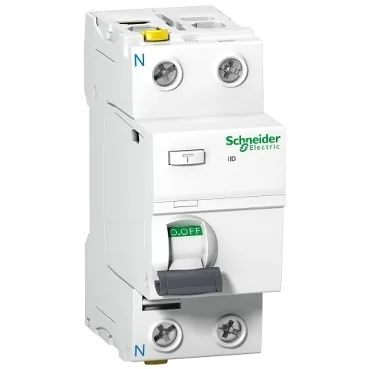
The Schneider Electric A9Z15240 is an Acti9 iID residual current circuit breaker (RCCB) in a 2-pole, 40 A frame, with a 300 mA earth-leakage sensitivity and a Type AC waveform classification. It is a selective (time-delay) device, meaning it coordinates with downstream RCCBs by riding out short-duration leakage pulses so the fault is cleared at the nearest device first — no need to gut the whole sub-board to isolate a single circuit.
Rated 40 A continuous at 220…240 V AC 50/60 Hz, so it handles the full load of a typical final sub-circuit feeding lighting, general-purpose sockets, or a small distribution board. The 300 mA sensitivity is not for personal shock protection (that calls for 30 mA or lower); it is sized for fire protection and equipment leakage monitoring — common on larger circuits where nuisance tripping from capacitive leakage would be a problem. The selective (S-type) time delay means it will hold through a downstream 30 mA RCCB trip cycle, so only the faulted branch opens. That is the value: one upstream device covers multiple downstream RCCBs without blacking out the whole board. The impulse withstand rating of 6 kV (Uimp) and the 8/20 µs surge test at 3,000 A mean it survives typical switching and lightning-induced transients without degrading — no need to derate or add series MOVs for ordinary mains-borne surges. The tripping technology is voltage-independent — the internal mechanism draws its operating energy from the residual current itself, not from the line voltage. That matters if you are retrofitting into an older panel where the neutral-to-earth voltage might be marginal or where a lost neutral would otherwise disable an electronic RCCB. It meets the line where it is, without requiring a separate neutral reference.
Terminals accept up to 35 mm² rigid or 25 mm² flexible on the front, and 25 mm² rigid or 16 mm² flexible on the back, with a wire-stripping length of 14 mm.