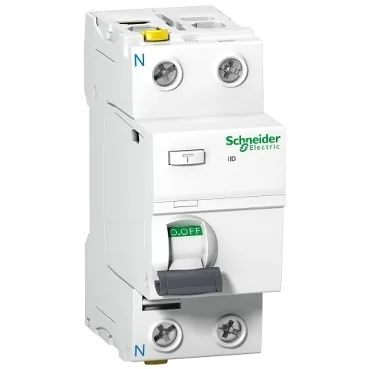
Its 80 A rated current (In) and 100 mA sensitivity (IΔn) define the load it can carry and the leakage threshold it detects: 100 mA is a common protection level for sub-distribution boards where a lower 30 mA sensitivity would cause nuisance tripping on long cable runs or equipment with natural leakage. The Type A-SI (Super Immunised) classification means it handles pulsed DC residual currents from single-phase rectifiers (typical of washing machines, LED drivers, EV chargers) and resists unwanted tripping from surge-induced high-frequency leakage up to 3000 A impulse (8/20 µs waveform, per EN/IEC 61008-1). That impulse withstand rating is the key differentiator — standard Type A RCCBs often nuisance-trip on lightning or switching surges; the SI variant holds through them.
DIN-rail mounting and panel fit
The neutral position is left, which matters when aligning with busbar feeders in a multi-module distribution board — verify the phase-neutral orientation before snapping it into the rail. IP20 rated for the device body, IP40 when enclosed in a modular enclosure per IEC 60529. The double-terminal front and back connections accept up to 35 mm² rigid or 25 mm² flexible, with a 14 mm wire stripping length and 3.5 N.m tightening torque. Padlocking provision allows lockout/tagout without removing the device.
Rated conditional short-circuit current (Icn) of 10 kA per EN/IEC 61008-1, with a making and breaking capacity (Idm/Im) of 1500 A. The 10 kA Icn means the RCCB can be installed downstream of a 10 kA-rated upstream MCB or fuse — coordination is required to ensure the upstream device clears faults above 1500 A before the RCCB contacts weld. Instantaneous tripping (no intentional time delay) means it provides fast protection but cannot be used for selectivity against a downstream 30 mA RCCB on the same circuit.
Environmental operating range
The -25 °C lower limit is worth noting for unheated enclosures in cold climates — many standard RCCBs derate or fail to trip below -5 °C. The 500 V rated insulation voltage (Ui) and 6 kV impulse withstand voltage (Uimp) confirm the insulation coordination for 230/400 V TN or TT systems.