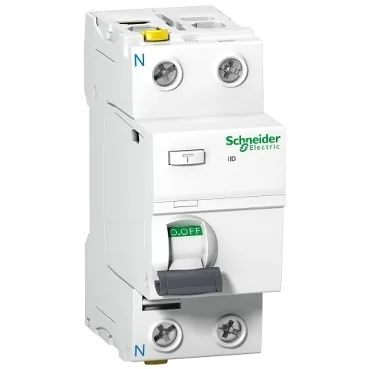
The Schneider Electric A9Z35240 is an Acti9 iID residual current circuit breaker (RCCB) — a 2-pole, 40 A device with 300 mA earth-leakage sensitivity, Type A-SI (Super Immunised) classification, and a selective (time-delayed) trip characteristic. It clips onto a DIN rail, occupies 4 x 9 mm pitches (36 mm wide), and is rated for 220-240 V AC 50/60 Hz networks.
The 40 A rated current (In) sets the continuous load it can carry in a 40 °C ambient — sized for a feeder or submain, not a final subcircuit. The 300 mA sensitivity is for equipment protection or circuits with high natural leakage (e.g., long cable runs, VFD-fed motors), not personnel protection (which requires 30 mA or lower). Type A-SI (Super Immunised) means it handles pulsed DC fault currents from rectified loads (single-phase drives, switched-mode supplies) and is immune to nuisance tripping from transient surges or high-frequency leakage — common on industrial lines with variable-speed drives or UPS systems. The selective (S-type) time delay coordinates with downstream 30 mA RCCBs: the downstream trips first on a ground fault, leaving the upstream A9Z35240 to hold until the fault clears or escalates. Rated conditional short-circuit current is 10 kA — it can withstand a 10 kA fault without rupturing, provided an upstream overcurrent device (MCB or fuse) clears the fault within its let-through. In practice, the 10 kA SCCR governs panel coordination: pair it with a 10 kA-rated MCB or fuse upstream. Voltage-independent tripping means the RCCB detects leakage and opens even if the phase voltage is lost — a safety advantage over electronic RCDs that need a control supply.
Deployment context
Clip-on DIN-rail mounting (4 modules wide) integrates into standard 35 mm rail enclosures.