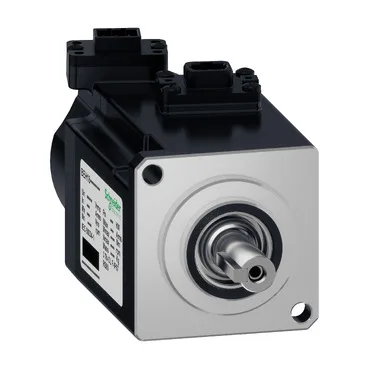
Active production — no lifecycle risk here
The BEH18LB0133CF5C: That means you can spec it into new designs and order production quantities without worrying about a last-time-buy deadline or a forced cross-reference.
Rated 100 W continuous power at 220 V single-phase input, with a nominal speed of 3000 rpm — this is a compact servo for light-duty positioning, indexing, or feed axes where the load torque stays under 0.32 N.m continuous. The peak stall torque of 0.96 N.m gives a 3× overload margin for acceleration and deceleration — enough to handle short-duration transient loads without tripping the drive. A holding brake rated at 0.32 N.m is built in — it locks the rotor when power is removed, so vertical or inclined axes stay put without a separate mechanical brake. The brake holding torque matches the continuous torque rating, which means it can hold the same load the motor can move.
Feedback and sealing for the environment
The 23-bit optical multi-turn encoder gives 8,388,608 counts per revolution — resolution fine enough for precision positioning down to arc-seconds with a matching drive and controller. IP67 protection means the motor body and shaft seal withstand direct hose-down and dust ingress — it runs in washdown zones, food processing areas, or outdoors without an additional cover. The Asian standard flange (40 mm square) and 8 mm shaft with parallel key are common for small-frame servo mounts — it bolts directly to the same pattern as other Lexium 18 frame sizes, so a panel layout change is minimal if you swap frame ratings.
Electrical and thermal constraints
Continuous stall current is 1.05 A; maximum permanent current is 3.15 A — the drive must be set to limit the RMS current to the continuous figure for sustained operation, with the peak allowed only during acceleration intervals. The torque constant of 0.305 N.m/A at 40 °C tells you the current-to-torque gain — at the continuous stall current of 1.05 A you get 0.32 N.m, matching the continuous torque spec. Derate the torque constant as winding temperature rises above 40 °C.