What sits on the machine flange
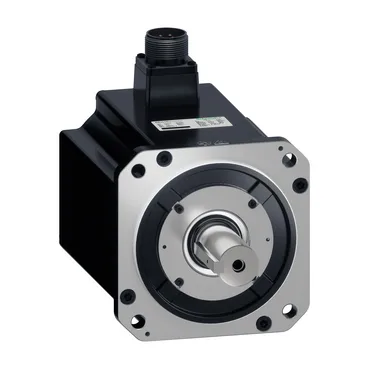
The BEH18LM5033MA6D is a Lexium 18 series servo motor from Schneider Electric — a 130 mm flange-frame, three-phase unit sized for the 5 kW slot in the lineup.
Power, torque, and the duty envelope
Continuous output is rated 5000 W at 380 V three-phase, with 15.8 N.m nominal torque and 3000 rpm nominal speed — that is the steady-state working point you size the gearbox and coupling around. Peak stall torque reaches 47.4 N.m at 380 V three-phase, so acceleration transients can pull roughly 3× nominal torque without tripping the drive's current limit, provided the Irms ceiling of 50.31 A is respected. The torque constant is 0.942 N.m/A at 40 °C and the back-EMF constant is 67.43 V/krpm at 40 °C — those two figures set how the drive must be current-tuned and what bus voltage the regeneration brake sees at top speed. Continuous stall current draws 16.77 A at standstill, which is the figure the drive's I²t model uses for thermal foldback during slow-index moves.
Mechanical fit — shaft, bearings, and thrust
Output shaft is 28 mm diameter by 63 mm long with an 8 mm parallel key — coupling selection must match that key width, and the shaft does not extend to a second end. Thrust limits are 196 N axial and 686 N radial; overhung loads from a belt or pinion need to be checked against the radial figure at the rated speed, not just at standstill. Mounting follows the Asian standard flange on a 130 mm bolt circle with four 9 mm holes, so existing Lexium 18 footprints and equivalent Asian-standard servo footprints drop in without a re-machined adapter plate. Mechanical speed is capped at 3000 rpm — push a 4-pole induction-style demand on top of that and the bearing life budget collapses.
Feedback, sealing, and the wiring side
Feedback is a 17-bit magnetic multi-turn encoder — multi-turn absolute position survives a power-cycle without a homing move on restart, which matters for machines that index from a stored recipe. IP67 sealing holds under washdown conditions, and the rotor is air-cooled — keep the housing fins clear of debris or the continuous-torque figure erodes faster than the datasheet would suggest. Two connectors (male/female pair) handle power and feedback; the rotor carries 10 poles, which sets the electrical-cycle-to-mechanical-revolution ratio for the drive's commutation.
Sourcing posture
Lifecycle stage reads as current, so the part is specified into the BOM from active distribution; quoting is against the BOM quantity with lead time and any volume break confirmed at RFQ.