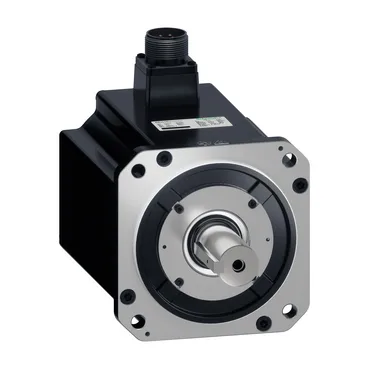
What you get for 5 kW at 380 V three-phase
The BEH18LM5033MF6D is a Lexium 18 servo motor in the BEH18 short-name family, sized for 5000 W continuous output at 380 V three-phase with a nominal speed of 3000 rpm — that combination is what makes it a fit for mid-range point-to-point axes and short-cycle rotary tables where the cycle time is set by acceleration under load, not by top-end speed. Continuous stall torque is 15.8 N·m and peak stall torque reaches 47.4 N·m at 380 V, so the drive sizing has to absorb roughly 3× the nominal figure on accel/decel transients — the peak is what governs the servo amplifier current rating, not the nominal.
Torque, current, and the wiring-side constants
Torque constant of 0.942 N·m/A at 40 °C and a back-EMF constant of 67.43 V/krpm at 40 °C define how the drive current translates to shaft effort and how the regeneration bus sees the motor at overspeed — the 50.31 A Irms maximum at 5 kW/380 V is the ceiling the amplifier must deliver under peak demand. Continuous stall current of 16.77 A lines up with the 15.8 N·m nominal figure through the torque constant; an integrator running the motor near stall for thermal soak should derate against this current rather than the headline 5 kW, because the winding heating — not the mechanical envelope — is what closes the duty window. The shaft takes a parallel key on a 28 mm diameter with 63 mm of usable length and an 8 mm key width, paired with the Asian standard 130 mm flange and 9 mm mounting holes — this is the dimension a retrofit has to clear before the cabling question is even opened.
Holding brake, encoder, and what gets bolted to the drive
A holding brake is fitted, with 16 N·m holding torque — sized to hold the rotor at zero speed against the load's static torque after a stop, which means the brake rating, not the motor's peak, is what gates a vertical-axis application where the load would otherwise back-drive on a power loss. Feedback is a 17-bit magnetic multi-turn encoder, which removes the need for an external battery box at the motor and lets the drive recover absolute position across power-downs — relevant when the cell has been sitting idle over a weekend and the homing sequence is too slow for the cycle budget. The motor connects through two male/female connectors for power and feedback; cooling is air-cooled with no secondary blower, so cabinet placement has to allow the shaft-fan airflow rather than packing the motor into a sealed bracket.
Mechanical envelope and IP67 duty
Maximum radial force of 686 N and maximum axial force of 196 N define the bearing-side budget — anything beyond that belongs on a separate thrust block or a redesigned coupling, not on the motor shaft.
Lifecycle and how to source it
A drop-in replacement on the same flange and the same 5000 W / 15.8 N·m envelope is what a retrofit looks for; if the original machine is a 1990s extrusion line or a packaging cell that has been re-engineered around the BEH18 short-name family, this motor meets it where it is without forcing a cabinet rework.