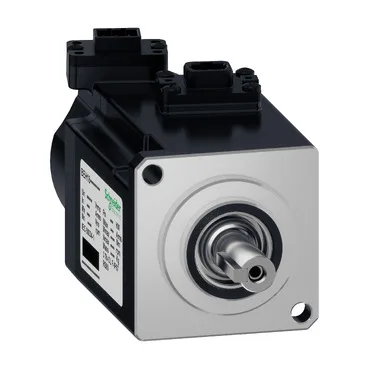
100 W servo with holding brake — Lexium 18 frame
The BEH18MB0133CF5C is a 100 W servo motor from the Schneider Electric Lexium 18 range, fitted with a holding brake and a 23-bit optic multi-turn encoder. It delivers 0.32 N.m nominal torque at 3000 rpm from a single-phase 220 V supply. The holding brake holds 0.32 N.m when the motor is unpowered — this is the same value as the nominal torque, so the brake matches the continuous torque rating exactly. That means the motor can hold a vertical load at rest without back-driving, which is the typical use case for a braked servo in a pick-and-place or Z-axis application.
Continuous stall torque is 0.32 N.m at 220 V single phase, with a continuous stall current of 1.1 A. The peak stall torque reaches 1.12 N.m — roughly 3.5× the continuous rating — which gives headroom for acceleration during short moves without oversizing the motor frame. The 23-bit optic multi-turn encoder provides 8,388,608 counts per revolution absolute position feedback. Multi-turn means the encoder tracks shaft position across multiple rotations even after power loss, so the controller knows the exact mechanical position on restart — no homing cycle needed after a power cycle. Rated for 3000 rpm maximum mechanical speed, with a torque constant of 0.29 N.m/A and back EMF constant of 20.1 V/krpm at 40 °C. The 10-pole motor design keeps cogging torque low for smooth low-speed operation.
Mounting and environmental sealing
Mounts on an Asian standard flange with a 40 mm flange size and 4.3 mm mounting holes. The shaft is 8 mm diameter with a 25 mm length and a 3 mm parallel key — this is a common small-frame servo interface for compact machine modules. IP67 protection rating means the motor body and shaft seal withstand washdown environments — suitable for food processing, packaging, or any line where hosed cleaning is routine. The electrical connection uses two male/female connectors; no second shaft end is fitted. Maximum radial force on the shaft is 78 N, maximum axial force 54 N. These limits govern bearing life in belt-drive or direct-couple applications — stay within them to avoid premature bearing failure.