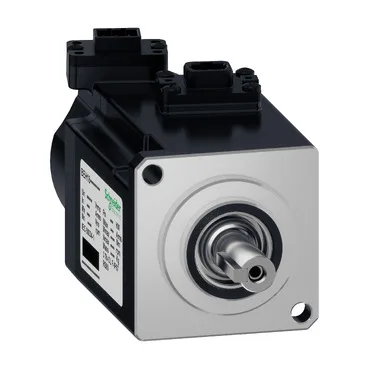
What the 100 W rating means for a small-axis build
The BEH18MB0133MF5C: The holding brake (0.32 N.m) locks the shaft when power is removed, which means the load stays put on a vertical axis or during an E-stop without a mechanical backstop. The brake engages automatically; no separate control signal is needed beyond the drive's brake-release output.
Encoder feedback and position hold after power loss
The 17-bit magnetic multi-turn encoder reports absolute position over 131,072 counts per revolution and tracks multiple shaft turns even when the system is unpowered. That eliminates the need for a homing cycle on every power-up — the drive reads the current position directly from the encoder when the bus voltage comes up. Magnetic encoder technology is inherently more tolerant of contamination than optical encoders — no glass disk to fog or scratch — which is one reason the motor carries an IP67 rating on the body. The encoder itself is sealed within the housing.
Mounting, shaft, and mechanical interface
The motor uses an Asian standard flange with a 40 mm square pilot — common on compact servo frames from several manufacturers. Four mounting holes on a 4.3 mm diameter circle secure the motor to the machine plate. The shaft is 8 mm diameter with a 25 mm length, fitted with a parallel key (3 mm key width). No second shaft end exists, so the rear of the motor is closed — no room for a manual crank or secondary encoder on the back side. Maximum radial force on the shaft is 78 N, and maximum axial force is 54 N. Exceed those limits and the bearing life drops sharply — budget a flexible coupling if the load applies side load.
Electrical parameters for drive tuning
The torque constant is 0.29 N·m/A at 40 °C, and the back EMF constant is 20.1 V/krpm. These two numbers let the drive calculate the current needed for a given torque and the voltage the motor generates as it spins. Continuous stall current is 1.1 A; peak current is 3.9 A for short-duration acceleration, delivering 1.12 N·m peak stall torque. With 10 motor poles, the electrical frequency at 3000 rpm is 250 Hz — the drive's current loop must handle that bandwidth. The single-phase input simplifies wiring in smaller panels but limits the available power compared to a three-phase supply.