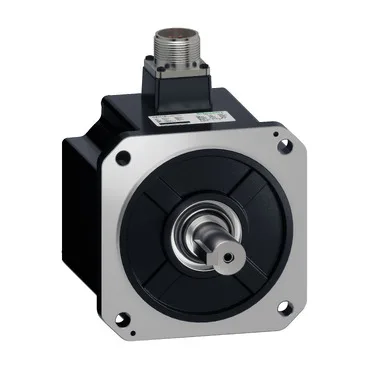
The BEH18MM1023CA6C is a 1 kW servo motor from Schneider Electric's Lexium 18 family, delivering 4.77 Nm nominal torque at 220 V single-phase input. That torque rating at 2000 rpm nominal speed means it handles moderate-inertia loads like indexing conveyors or rotary tables without needing a gearbox for torque multiplication. The 23-bit optic multiturn encoder gives 8,388,608 counts per revolution absolute position feedback — no homing cycle needed after power loss, which matters for a gantry or pick-and-place axis where lost position means a crash. IP67 rating means the motor body and shaft seal withstand washdown — suitable for food-and-bev lines or outdoor conveyor sections where high-pressure spray is routine. No secondary cover needed.
Torque, speed, and acceleration envelope
Peak stall torque hits 14.31 Nm at 220 V — that's 3× the continuous rating, enough for a short-burst acceleration or clearing a jam without oversizing the motor frame. The continuous stall current is 5.31 A, but the maximum permanent current is 15.93 A; the drive must be sized for that peak current if you plan to use the full transient capability. Torque constant is 0.898 N·m/A at 40 °C, and the back EMF constant is 62.73 V/krpm. These numbers let you calculate the drive bus voltage needed to reach full speed under load — at 3000 rpm the back EMF is 188 V, leaving headroom for a 220 VAC rectified bus (about 310 VDC).
Mounting, shaft, and mechanical interface
Maximum radial force is 686 N and maximum axial force is 196 N — these are the bearing load limits. A belt drive pulling radially must stay under that 686 N at the shaft centerline, or the bearing life drops fast. No holding brake on this variant — the 'CA6C' suffix indicates 'without brake.' If the axis needs to hold position with power off, you'll need an external brake or a different motor variant with the brake option. Electrical connection uses two connectors (male/female) — one for power, one for feedback. The 10-pole motor design gives smoother torque ripple than an 8-pole at low speeds, which helps contouring accuracy.