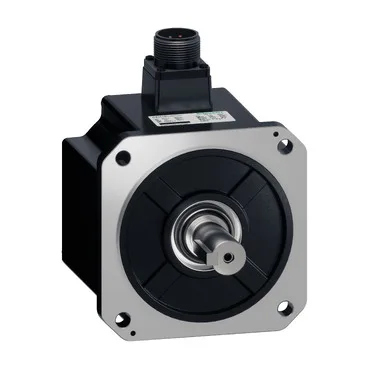
Frame size, flange, and what fits in the cabinet
The BEH18MM1523CA6D: The shaft is 22 mm diameter, 58 mm long, with a parallel key (key width 8.0 mm) and no second shaft end.
Torque, speed, and the load it will move
Rated at 1.5 kW continuous output power on three-phase 380 V, the motor delivers 7.16 Nm nominal torque (also the continuous stall torque) at 2000 rpm. Peak stall torque reaches 21.48 Nm — useful for acceleration transients, but the drive must limit the RMS current to stay within the continuous stall current of 4.27 A. Maximum mechanical speed is 3000 rpm, so the nominal 2000 rpm operating point leaves headroom for field weakening or high-speed cycles. The 10-pole motor design keeps the torque ripple low across the speed range.
Feedback resolution and loop tuning
The 23-bit optic multi-turn encoder gives 8,388,608 counts per revolution — enough resolution for sub-arc-minute positioning and smooth velocity control down to single-digit rpm. The optic encoder type is less susceptible to magnetic interference than a resolver, but the glass disc means shock and vibration limits matter during installation.
Motor constants for the drive engineer
Torque constant Kt is 1.677 N·m/A at 40 °C, and the back-EMF constant Ke is 110.2 V/krpm at 40 °C. These numbers let the drive calculate the current needed for a given torque and the voltage required to reach speed — expect the drive's DC bus to need at least 380 VDC to spin at 2000 rpm against the back-EMF. Maximum continuous current (Irms) is 12.8 A at 1.5 kW, 380 V. The continuous stall current is lower at 4.27 A — the difference reflects the cooling airflow at speed vs. stalled conditions. Air-cooled, so forced ventilation from the driven load or an external fan helps at low speeds.
Bearing loads and mechanical interface
Maximum radial force Fr is 686 N, maximum axial force Fa is 196 N. These are the static load limits at the shaft shoulder — belt drives or direct couplings must stay within these to avoid bearing brinelling. The parallel key transmits torque; no holding brake is fitted on this variant, so the load must be held by the drive's holding brake or an external mechanical brake.