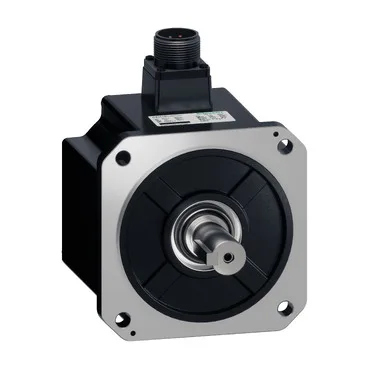
Lexium 18 servo motor for motion control axes
The BEH18MM1523MA6D is a 1.5 kW servo motor from the Schneider Electric Lexium 18 range, designed for precise speed and torque control in automated machinery. It delivers 7.16 N.m nominal torque at 2000 rpm on a 380 V three-phase supply, with a peak stall torque of 21.48 N.m for short-duration acceleration loads. The 17-bit magnetic multi-turn encoder provides absolute position feedback over multiple shaft revolutions, eliminating the need for a home cycle on power-up in applications like pick-and-place, packaging, or material handling.
Torque and thermal limits for sizing
Continuous stall torque is 7.16 N.m at 4.27 A continuous stall current, with a torque constant of 1.677 N.m/A at 40 °C — this is the linear torque-per-amp figure for sizing the drive's current loop. The maximum permanent current is 12.8 A, which corresponds to the peak stall torque region; sustained operation above the continuous stall current requires duty-cycle derating to avoid winding overtemperature. The motor is air-cooled (self-ventilated) with no separate blower, so the duty cycle must account for natural convection in the enclosure. The back EMF constant of 110.2 V/krpm at 40 °C sets the voltage ceiling the drive must supply at top speed — at 3000 rpm the back EMF reaches about 330 V line-to-line, leaving headroom on a 380 V bus.
Mounting and mechanical interface
The motor uses an Asian standard flange with a 130 mm flange size and four mounting holes — common on machines built to Japanese or Chinese machine-tool standards. The shaft is 22.0 mm diameter with a parallel key (8.0 mm key width) and 58.0 mm shaft length, which mates with standard timing-belt pulleys or direct couplings in that bore range. Maximum radial force is 686 N and maximum axial force is 196 N — these are the bearing load limits for belt-drive or overhung-load applications. Exceed these and the bearing life drops fast; a coupling misalignment that pushes radial load past 686 N will show up as vibration before the bearing fails. The electrical connection uses two male/female connectors — one for power, one for feedback. No holding brake is fitted (: Without), so the load must be held by the drive's holding brake or an external mechanical brake when power is off.