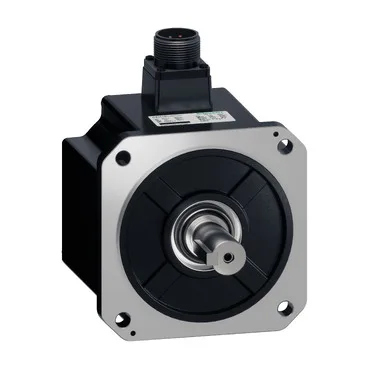
1.8 kW servo motor with brake — Lexium 18
The BEH18MM1813CF6D is a Schneider Electric Lexium 18 servo motor rated for 1800 W continuous power at 380 V three-phase supply, delivering 11.5 N.m nominal torque at 1500 rpm. Peak stall torque reaches 34.5 N.m, with a holding brake rated at 16.0 N.m to lock the shaft when power is removed — essential for vertical-axis or safety-critical applications where load must not drift.
Encoder resolution and feedback
Feedback comes from a 23-bit optic multi-turn encoder, giving 8,388,608 counts per revolution — enough resolution for smooth low-speed control and precise positioning loops in pick-and-place or winding applications. The optic encoder type provides clean position data without magnetic flux interference, suited for machine-tool spindles or gantry axes where repeatability matters.
Mechanical integration and cooling
Mounts on an Asian standard flange with 130 mm flange size, four mounting holes, and a 22 mm shaft diameter with parallel key — fits common servo-mount patterns in packaging and material-handling machinery. Air-cooled design with IP67 protection means the motor body and shaft seal withstand hose-down cleaning — direct-fit for food-and-bev or washdown zones without an extra shroud.
Electrical characteristics and drive pairing
Continuous stall current is 7.03 A; maximum permanent current (Irms) is 21.09 A at 1.8 kW, 380 V. The torque constant of 1.636 N.m/A at 40 °C lets the drive calculate torque from current feedback directly. Back-EMF constant is 110.11 V/krpm at 40 °C — the drive's DC-bus voltage must be high enough to overcome this at maximum speed. With 10 motor poles, the electrical frequency at 3000 rpm is 250 Hz, within the range of standard Lexium 18 drives. Maximum radial force on the shaft is 686 N, axial force 196 N — budget these when coupling to a belt or lead-screw to avoid bearing overloading.
Electrical connection uses two male/female connectors. No direct successor or cross-reference is recorded; the Lexium 18 family is the current generation, so no forced migration is expected.