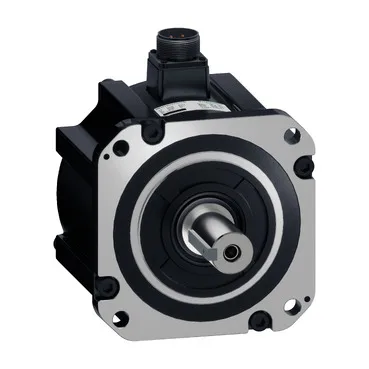
What this servo motor delivers on the line
The BEH18MR2913MA6D is a 2.9 kW servo motor from the Lexium 18 range, rated for 1500 rpm nominal speed at 380 V three-phase. Nominal torque sits at 18.46 N.m, with a peak stall torque of 55.38 N.m — enough headroom for acceleration spikes in pick-and-place or indexing applications. The 17-bit magnetic multi-turn encoder gives absolute position feedback across 131,072 counts per revolution, so the drive knows the rotor angle at power-up without a homing move. No holding brake on this variant — the load must be self-locking or a separate brake resistor handles the deceleration energy. IP67 rating means the motor body and shaft seal withstand washdown environments — food processing, packaging, or any line where hoses are part of the cleaning cycle. Air-cooled, so keep the ambient airflow path clear; the frame depends on convection, not a fan.
Mounting and mechanical fit — what the flange tells you
Asian standard flange, 180 mm flange size, four mounting holes. The shaft is 35 mm diameter with a parallel key (10 mm key width), 79 mm shaft length — no second shaft end. That matches the common IEC 72-1 B5 / IM B5 footless flange pattern used across many Asian-origin machine frames. Maximum radial force Fr is 1470 N, axial force Fa 490 N. If the belt or coupling applies a side load above that, the bearing life drops fast. The 3000 rpm maximum mechanical speed is the bearing limit, not the electrical limit — the drive sets the actual speed ceiling.
Electrical ratings and drive pairing
Continuous stall current is 10.26 A; maximum permanent current (peak) is 30.78 A at 2.9 kW, 380 V. The torque constant is 1.8 N.m/A at 40 °C — so every amp of continuous current delivers 1.8 N.m. Back EMF constant is 118.69 V/krpm, which limits the bus voltage headroom at high speed; a 380 V drive can spin this motor to about 3200 rpm before the back EMF matches the bus. The 10-pole motor design gives a lower cogging torque ripple than a 4- or 6-pole equivalent, which matters for contouring and surface-finish applications. Electrical connection is via two connectors (male/female) — the power and feedback cables are separate, so a damaged cable doesn't pull the encoder line out.