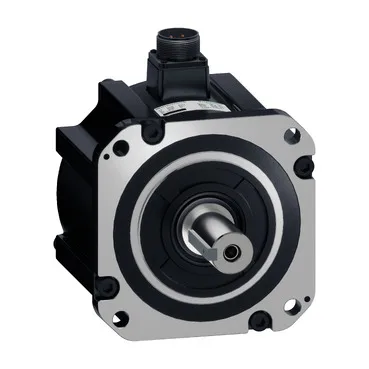
The BEH18MR4413CF6D is a 4.4 kW servo motor from the Lexium 18 family, rated for 1500 rpm nominal speed at 380 V three-phase supply. The 28.4 Nm nominal torque and 71 Nm peak stall torque give it the headroom for intermittent overloads common in indexing or cut-to-length applications — the peak figure is 2.5× the continuous rating, so a 1-second peak every 10 seconds stays within thermal limits. The 23-bit optic multi-turn encoder provides 8,388,608 counts per revolution absolute position — enough resolution for sub-arcminute positioning on a rotary table without a separate encoder. The multi-turn tracking survives power loss, so homing on restart is unnecessary for most pick-and-place cycles. IP67 protection means the motor body and the shaft seal withstand washdown with a hose from any direction — the connector O-rings are the wet-end barrier, not the housing thread. This suits food-and-bev or washdown zones where a standard IP54 motor would fail from moisture ingress through the breather.
Mounting and mechanical integration
The motor uses an Asian standard flange with a 180 mm flange size and four mounting holes — the bolt pattern matches the common 180 mm frame standard used across Japanese and Chinese machine builders. The 35 mm shaft with a parallel key and 79 mm shaft length accepts standard timing-belt pulleys or direct couplings with a keyway. Maximum radial force is 1470 N at the shaft centre; maximum axial force is 490 N. For a belt-drive application, the belt tension must stay below the radial limit — a 25 mm wide timing belt at 500 N preload is fine, but a wider belt at 2000 N tension would exceed the bearing rating and shorten life.
Electrical and thermal parameters for drive tuning
Stator resistance is 0.391 Ohm and torque constant is 1.821 Nm/A at 40 °C — the drive's current loop gains are calculated from these values. Back EMF constant is 125.24 V/krpm at 40 °C, meaning at 1500 rpm the motor generates 188 V line-to-line back EMF; the drive's DC bus must be at least 340 V to maintain current control at full speed. Continuous stall current is 15.6 A; maximum current is 37.8 A at 4.4 kW and 380 V. The drive must supply at least 38 A peak for the 71 Nm peak torque — a drive rated for 40 A peak is marginal; a 50 A peak drive gives headroom for the current loop. The 10-pole design (vs the more common 8-pole) produces lower torque ripple at low speed — the cogging frequency is higher and easier for the drive to filter. Maximum mechanical speed is 3000 rpm, so the motor can run at 2× nominal speed for rapid-traverse moves if the load inertia allows.
The electrical connection uses two connectors (male/female) — the power and feedback cables are separate, which simplifies replacement without pulling the full harness. The holding brake is rated for 50 Nm holding torque, enough to hold the vertical axis load without a separate mechanical brake when the drive is disabled.