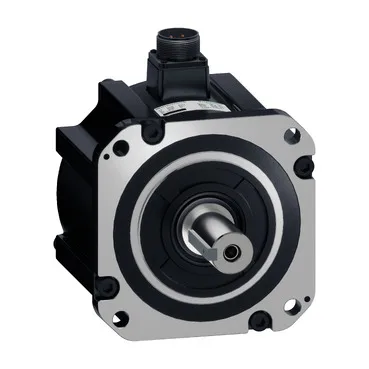
35 N.m continuous, 5500 W at 380 V three-phase
The BEH18MR5513CA6D is a Schneider Electric Lexium 18 brushless AC servo motor in the 180 mm flange family, rated 35 N.m of continuous torque and 5500 W of continuous output power at 380 V three-phase, with a 1500 rpm nominal speed on that duty point. That envelope maps to mid-range machine axes — packaging indexing tables, converting-line winders, and converting or feeding sections where the load profile sits comfortably inside the continuous rating with headroom for acceleration transients. Peak stall torque is 87.5 N.m at 380 V three-phase, and the maximum mechanical speed is 3000.0 rpm — so the motor can roughly 2.5× its continuous torque for short acceleration phases before the drive hits the current ceiling of 45.08 A Irms at the 5500 W, 380 V point. For sizing, that peak/continuous ratio is the figure that decides whether the axis profile actually fits, not the headline torque number alone.
Encoder feedback and the brake note
Feedback is a 23-bit optical multi-turn encoder, which gives sub-arc-minute absolute position retention across power cycles — relevant for machines that index to a home position on every restart without a separate homing routine, and for safety-rated axes that need a reliable absolute reference after an E-stop. Despite sitting under the Servo Motors with Brake category, this code is recorded as supplied without a holding brake. If the axis needs a fail-safe brake for vertical load or gravity-loaded stop, the brake has to be specified separately or a different variant in the Lexium 18 family selected; the shaft and frame dimensions otherwise match the braked siblings on this 180 mm flange footprint.
IP67 sealing for washdown and harsh-cabinet duty
The motor is rated IP67, meaning the housing and shaft seal withstand immersion and high-pressure washdown — appropriate for food-and-beverage lines, pharmaceutical conveyors, and any machine where the cabinet side of the servo gets cleaned down rather than just wiped. Air cooling keeps the thermal path simple (no liquid coolant loop to plumb into the cabinet) but also means the continuous-torque figure assumes the surrounding air stays within the motor's thermal envelope.
Frame, shaft, and the load limits that decide mechanical fit
Mounting is via an Asian-standard flange with four mounting holes on a 180 mm motor flange size; the parallel-key shaft is 42.0 mm in diameter with a 12.0 mm key width and a 113.0 mm shaft length. Maximum radial force is 1764 N and maximum axial force is 588 N — these are the figures that decide whether the coupling, pulley, or pinion sits close enough to the housing shoulder to keep bearing life inside the maintenance window.
Motor constants and pairing with the drive
Electrical constants for sizing the drive current loop: torque constant 1.77 N.m/A at 40 °C, back-EMF constant 121.39 V/krpm at 40 °C, stator resistance 0.134 Ohm, ten motor poles, and continuous stall current 19.77 A. The continuous stall figure is the lower of the two current numbers in the data — the 45.08 A maximum Irms governs short-term overload, and the drive must be rated to deliver that without tripping.