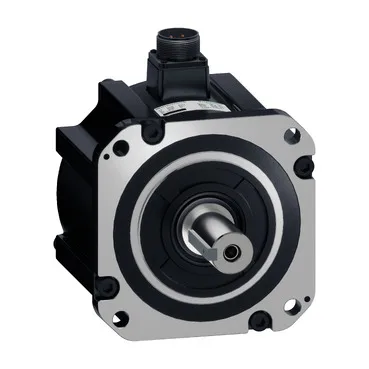
Sizing a 7.5 kW servo into a machine envelope
The BEH18MR7513CF6D sits in the Lexium 18 family as a three-phase servo rated 7500 W continuous output at 380 V, paired with a 48 N.m nominal torque and 50 N.m holding torque, so it covers the heavy end of mid-power motion axes — the kind of duty seen on machine-tool spindles, large-format gantries, and packaging indexing tables where a 7.5 kW continuous draw is expected. Peak stall torque lands at 120 N.m, which is 2.5× the nominal figure — that headroom is what lets the drive accelerate a heavy inertial load through a short index before the continuous rating takes over on the dwell. Nominal speed is 1500 rpm with a maximum mechanical speed of 3000 rpm, so the constant-power region above base speed is roughly 2:1 — beyond 1500 rpm the available torque falls off as the back-EMF rises (127.67 V/krpm at 40 °C), and sizing above that point has to respect the inverse-speed curve rather than the nominal torque number.
Current draw, rotor inertia, and the load the drive has to move
Continuous stall current is 26.45 A with a maximum permanent current of 60.23 A at the 7.5 kW / 380 V rating — the 2.3× peak-to-continuous ratio is what the upstream servo drive has to supply during acceleration, and it sets the sizing margin on the drive's continuous current channel. The torque constant of 1.815 N.m/A at 40 °C is the figure to use when converting a demanded acceleration torque into a current command — every N.m of dynamic torque above the steady-state load draws roughly 0.55 A from the drive bus. Maximum radial force is 1764 N and maximum axial force 588 N on the shaft — these are the limits beyond which the bearings take damage rather than the windings, so any overhung pinion or belt drive has to be sized for belt tension and overhung load within those numbers.
Feedback, brake, and what mounts on the panel
Feedback is a 23-bit optical multiturn encoder — 23 bits single-turn gives roughly 8 million counts per revolution, with the multiturn tracking absolute position through power cycles, which is what lets the controller resume a stopped axis without a homing return on every restart. A holding brake is included, so the motor holds the load at standstill after the bus is de-energised — typical for vertical-axis applications where gravity would otherwise back-drive the axis on power loss. The shaft is 42.0 mm diameter with a 12.0 mm parallel key, 113.0 mm long, no second shaft end — that key dimension is what the mating pulley, pinion, or coupling has to match, and it's the point on the motor where radial and axial load limits apply. Mounting is an Asian-standard flange at 180 mm, with IP67 sealing on the body — IP67 here means the motor housing withstands temporary immersion, which is the rating expected for washdown-prone food-and-bev lines and outdoor skids where the motor is exposed to hose-directed water. Connection is through two male/female connectors and cooling is air-cooled — meaning the heatsink relies on the panel airflow and the motor body has to keep its surface within the rated thermal envelope; in a sealed cabinet, derating the continuous torque for the ambient temperature is the usual corrective step.