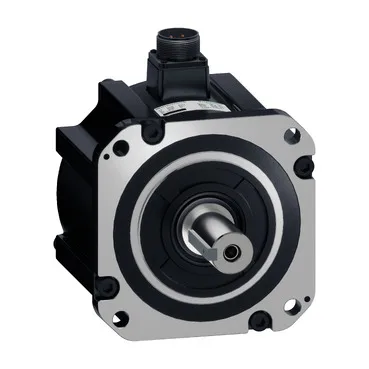
The BEH18MR7513MA6D is a member of the Lexium 18 series of brushless AC servo motors, a mid-power position in Schneider's servo range designed to pair with Lexium 18 (and compatible LXM-family) servo drives for precision motion axes in industrial automation. Feedback is integrated on the shaft as a 17-bit magnetic multi-turn encoder — that resolution and the absolute multi-turn tracking let the drive retain position through power-cycle events without a separate homing routine on every restart. The motor is air-cooled and ships without a holding brake, so any axis hold requirement at zero speed has to come from the drive's active braking loop or a separately mounted brake on the gear train — a relevant point for vertical or gravity-loaded axes.
Continuous and peak torque envelope
Continuous output is rated 7500 W at 380 V three-phase, with 48 N.m of nominal torque and a 1500 rpm nominal speed — that places the BEH18MR7513MA6D squarely in the 7.5 kW class used for machine tool spindles, indexing tables, packaging conveyors, and larger pick-and-place axes. Peak stall torque reaches 120 N.m at 380 V, giving a roughly 2.5:1 overload margin above continuous — the figure the drive uses during acceleration ramps and emergency-stop braking peaks before the I²t foldback triggers. Maximum current Irms is 60.23 A at the 7.5 kW, 380 V operating point, while continuous stall current sits at 26.45 A — both numbers drive servo drive sizing and the continuous-current headroom in the sizing tool.
Winding characteristics and what they tell the integrator
Torque constant is 1.815 N.m/A at 40 °C and the back-EMF constant is 127.67 V/krpm at the same reference — the two figures are linked through the same flux design and let you back-calculate expected motor terminal voltage at a given speed, which matters when the DC bus sits at 540 V from a 380 V rectified supply. Stator resistance is 0.134 Ohm — the I²R loss floor at 26.45 A continuous stall current is roughly 94 W per phase, the baseline thermal load the cooling solution must remove before friction and iron losses are added.
Shaft, flange, and the mechanical interface
The motor mounts via an Asian-standard flange with a 180 mm flange size and four mounting holes, with a 42 mm shaft diameter, 113 mm shaft length, and a 12 mm parallel key — confirm the mating coupling or pinion bore against these dimensions before mechanical fit-up. Maximum axial force Fa is 588 N and maximum radial force Fr is 1764 N — these are the bearing load limits at the shaft end and constrain the overhung load from a pinion or belt pulley; a separate radial load calculation should be done before mounting any external gear element.
Speed, cooling, and environmental ratings
Maximum mechanical speed is 3000 rpm and the housing carries an IP67 protection rating with air cooling — IP67 means the motor body and shaft seal can withstand temporary immersion, suitable for washdown areas in food, beverage, and pharmaceutical lines. The 10-pole rotor at a nominal 1500 rpm on a 380 V three-phase supply places the fundamental electrical frequency around 125 Hz — keep that in mind for any line-filter or EMC component sizing near the drive cabinet.