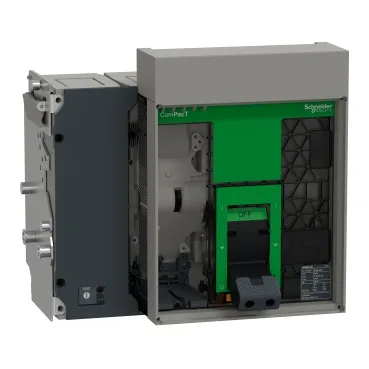
The drawout chassis means you can rack the unit out for inspection or replacement without disconnecting the main bus — a real time-saver in switchgear where uptime matters.
Rated operational current sits at 800 A across the AC-23A utilization category from 220 V up to 690 V. That's the motor-switching curve — high inrush on make, high stress on break — so this frame handles motor loads directly, not just resistive heating. The conventional free-air thermal current (Ith) is also 800 A at 60 °C, meaning the continuous current rating isn't derated from the switching rating; you get the full 800 A in continuous duty up to that ambient. Short-time withstand (Icw) is 25 kA for 0.5 s, and 4 kA for 20 s. That 25 kA / 0.5 s figure is what you coordinate against upstream breakers — it tells you this switch can hold in on a fault long enough for the downstream protection to clear, without welding contacts. Impulse withstand voltage (Uimp) is 8 kV, which covers most industrial installations against lightning or switching surges. Pollution degree 3 per IEC 60947-3 means it's rated for the conductive-dust and condensation environment you'd expect in an unheated electrical room or a factory floor panel.
Drawout (withdrawable) mounting means the chassis stays bolted to the panel, and the switch body slides in and out on rails.
IP40 protection keeps out tools and wires >1 mm; IK07 means it survives a 2 J impact — enough for accidental hammer knocks during panel work. Mechanical durability is 10,000 cycles; electrical durability is 2,000 cycles at 440 V — that's typical for a switch disconnector of this class, not a daily-switching contactor, but fine for infrequent isolation and motor-switching duty.