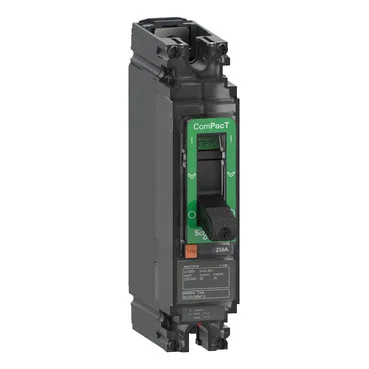
The TM-D trip gives you thermal overload protection (L) and magnetic short-circuit protection (I), so it handles both sustained overloads and fault clearing in one device. Breaking capacity is 18 kA Icu at 220/240 V AC, 50/60 Hz per IEC 60947-2. At 250 V DC it's rated 36 kA Icu, which is useful for DC bus or battery-string protection where the DC fault rise is slower but sustained.
Fixed-mount, backplate installation. The 35 mm width per pole matches the standard DIN-rail component pitch, but it's not a snap-on DIN breaker — it bolts to a backplate, so factor in drilling and mounting hardware. Dimensions are 161 mm high by 35 mm wide by 86 mm deep, which fits a standard distribution board cutout. Horizontal or vertical mounting is allowed, which helps when you're tight on panel height. Front connection both top and bottom. That means busbar or cable entry and exit are on the same plane, simplifying wiring in a shallow enclosure. Connection pitch is 35 mm, so standard comb busbars for the NSX range fit without adapters. Power dissipation per pole is 4.11 W. For a 1-pole breaker at 50 A, that's about 4 W of heat dumped into the enclosure.
What the standards tell you
EN/IEC 60947-2 is the standard for low-voltage switchgear and controlgear — specifically for circuit breakers. It covers the breaking capacity, utilization category (Category A here, meaning it's not specifically intended for selectivity under fault), and isolation suitability. That's the typical factory floor or substation condition — not clean-room, not outdoor without a weatherproof enclosure. Overvoltage category IV means it's suitable for installation at the origin of the installation, before the main distribution board — the point with the highest expected transient overvoltages. That's consistent with a main breaker or feeder breaker role.