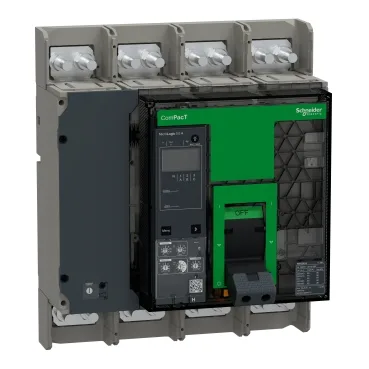
The C125H45AFM is a Schneider Electric ComPacT NS new generation moulded-case circuit breaker, 4-pole, fixed-mount, rated 1250 A at 50 °C with a MicroLogic 5.0 A electronic trip unit. It belongs to the ComPacT NS630b...1600 new generation range — the current-production platform that replaced the earlier NS series. The 70 kA Icu at 415 V AC (EN/IEC 60947-2) means it clears a 70 kA prospective fault current at typical European distribution voltage without welding or rupturing; the 65 kA at 440 V and 50 kA at 525 V tell you it holds up through the common global voltage bands. The trip unit is MicroLogic 5.0 A — electronic, with LSIG protection: L (long-time overload), S (short-time short-circuit), I (instantaneous short-circuit), and G (ground-fault, implied by the '5.0' designation even if not fully spelled in the spec line). That makes it suitable for distribution feeders where you need adjustable time-current curves and ground-fault coordination, not just a thermal-magnetic trip. The LCD display and ammeter measurement let you read load current and trip event data locally — useful during commissioning and fault diagnosis without needing a laptop.
Fixed-mount backplate installation, 280 mm wide, 327 mm high, 147 mm deep. The 4-pole unit with neutral on the left and a 70 mm connection pitch means the busbar or cable landing pattern is set — verify your existing drop-out dimensions if retrofitting into an older panel. Front-connected both top and bottom, so cabling runs straight in and out without rear-access requirements.
Endurance and operating conditions
Mechanical durability is 10,000 cycles; electrical durability ranges from 2,000 cycles at 690 V full-rated current up to 5,000 cycles at 440 V at half current. That is standard for a distribution MCCB in this frame size — not a motor-switching device, but fine for infrequent load-break and fault-isolation duty. Power losses are 44 W at rated load, which matters for panel thermal calculations if the enclosure is tightly packed. The thermal memory (20 minutes) means the trip curve remembers prior heating after a trip — prevents immediate reclose on a still-hot conductor.