What this is — and what it isn't
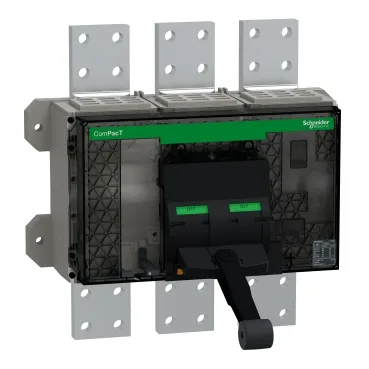
The C16BN3FM is a basic frame — the structural and mechanical core of a Schneider Electric ComPacT NS1600bN new-generation air circuit breaker. It carries no electronic trip unit (that's ordered separately as a Micrologic control unit), no internal protection settings, and no auxiliary contacts. What it does deliver is the 3-pole fixed-mount chassis, the manual operating mechanism, and the full interrupting capacity of the NS1600bN platform: 85 kA Icu at 240 V AC, 70 kA at 415 V AC, and 65 kA all the way up to 690 V AC, all per IEC 60947-2.
Rated 1600 A continuous at 50 °C ambient — that's the thermal limit for the frame itself, not a trip setting. At 40 °C the same frame carries its full In without derating; above 50 °C you follow the manufacturer's thermal curve. The short-time withstand (Icw) is 32 kA for 3 seconds, which is the frame's ability to pass fault current while the upstream protection clears — critical for selective coordination studies. Breaking capacity is given as both Icu (ultimate) and Ics (service). At 415 V, Icu is 70 kA and Ics is 52 kA — meaning after one fault at 52 kA the breaker can be reclosed and remain in service. That 75% Ics/Icu ratio is standard for distribution-grade frames. The integral instantaneous withstand (the let-through the frame can handle without a trip unit) is 130 kA peak.
This is a current-production item — Schneider's ComPacT NS1600bN new generation is the active platform, not a phase-out line. The C16BN3FM is the basic frame variant; the full catalog includes versions with various Micrologic trip units (electronic, advanced, or energy-metering) and different breaking capacities (N, S, H). Because it's a basic frame, it's typically ordered as part of a configured breaker assembly.