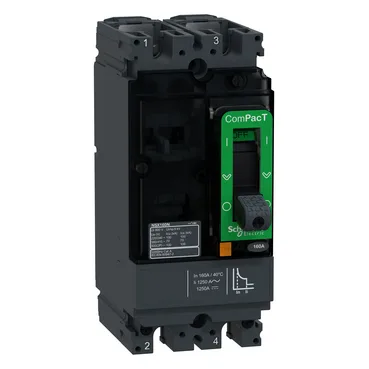
The C16S2TM160 is a Schneider Electric ComPacT NSX160S moulded-case circuit breaker (MCCB) with a 160 A TM-D thermal-magnetic trip unit, 2-pole configuration, and an S-frame breaking capacity class — 70 kA Icu at 415 V AC. That 70 kA at 415 V is the number that governs most industrial distribution panels in 400 V-class systems; it means this breaker can safely interrupt a fault current up to 70,000 A without welding contacts or rupturing the case, which is the threshold for selective coordination with downstream feeders. At 220/240 V AC the same breaker delivers 100 kA Icu, and at 690 V AC it still holds 10 kA — so it covers LV switchboards from 240 V through 690 V without a frame-size jump. The TM-D trip unit provides thermal overload protection (L) via a bimetal element and magnetic short-circuit protection (I) via a solenoid — no electronic adjustments, no auxiliary power needed. Mounts fixed to a backplate, accepts horizontal or vertical orientation, and carries IP40 front-face protection (IK07 impact rating) — fine for enclosed distribution boards but not for washdown zones.
Physical footprint: 161 mm high, 70 mm wide, 86 mm deep. Fixed-mount only — no draw-out cradle. The toggle handle protrudes from the front face; plan for at least 100 mm of clearance above the breaker for handle swing and arc-chamber venting. Power dissipation per pole is 13.95 W at rated current — three poles total would be about 42 W dissipated inside the enclosure. For a multi-breaker panel, that heat load needs to be factored into the cabinet's thermal design, especially if the panel is sealed to IP54 or higher. The breaker itself is rated for 0–95% relative humidity and 0–2000 m altitude without derating; above 2000 m, derate per the manufacturer's curve. Mechanical durability is 20,000 cycles; electrical durability is 20,000 cycles at 277 V at half rated current, or 10,000 cycles at full rated current. For frequent switching applications (like capacitor bank or motor feeder duty), those numbers set the service-life expectation — not a daily-switch application, but fine for infrequent manual isolation or backup breaker operation.