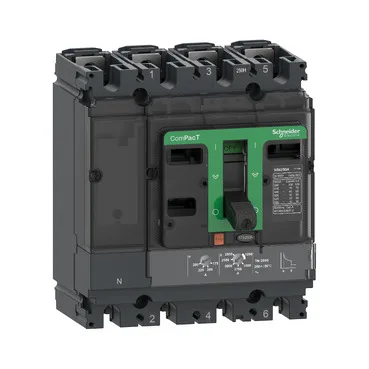
That trip unit gives you L (thermal overload) and I (magnetic short-circuit) protection in one block — no separate relay or CTs needed for the basic protection scheme. The 200 A rating at 50 °C means you size it for a 200 A bus or feeder at that ambient; if your panel runs hotter, you derate per the manufacturer's curve. Breaking capacity is the headline number for coordination studies: 70 kA Icu at 415 V AC, 65 kA at 440 V, 50 kA at 500 V, and 35 kA at 525 V. At 220/240 V it hits 100 kA Icu. These are ultimate breaking capacities per IEC 60947-2 — the breaker can interrupt a fault at those levels and still be serviceable afterward. For a 415 V distribution board with a transformer upstream that can deliver 50 kA fault current, this holds without cascading upstream. It's a 4-pole (4P) device with the neutral on the left, configured for 3D neutral protection (no protection on the neutral pole). That's typical for distribution where the neutral is solidly bonded and doesn't need its own trip element. The toggle control is manual — no motor operator or remote closing mechanism built in, though add-on accessories are available in the NSX platform.
Front connections both top and bottom make it straightforward for panel builders using busbar stacks or cable lugs. IP40 enclosure protection means it's fine inside a clean panel; IK07 impact rating handles the odd dropped tool during commissioning.
Certified to EN/IEC 60947-2, with suitability for isolation marked on the device. That means when you open it, you can verify isolation visually — no separate disconnect switch needed upstream for maintenance access. The IP and IK ratings are tested per IEC 60529 and IEC 62262 respectively. Electrical durability: 20,000 cycles at 440 V at half rated current, 10,000 cycles at full rated current. That's typical for a distribution MCCB — not a switching device for frequent motor starts, but fine for infrequent manual switching and fault interruption.