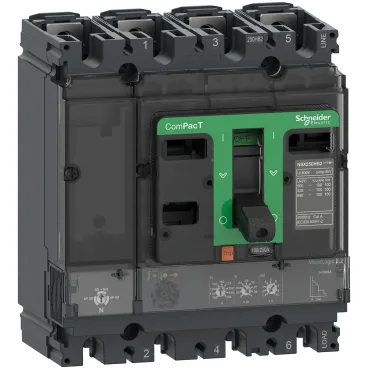
It carries a MicroLogic 2.2 electronic trip unit rated 100 A at 40 °C — that is the continuous current it handles without derating at that ambient, so for a 40 °C panel environment this is your full-load ampacity. The 4-pole (4P) configuration with neutral on the left suits three-phase plus neutral distribution boards where you need all poles protected. Breaking capacity is the headline: 50 kA Icu at 415 V AC (the N code rating), 90 kA at 240 V, and still 35 kA at 525 V. The NSX250N frame (device short name NSX250N) tells you the physical platform supports up to 250 A, so this 100 A unit has thermal and magnetic headroom in the same footprint. Mounting is backplate (not DIN rail), with front upside and downside connections at a 35 mm pitch.
Protection logic and trip unit behaviour
Category A utilisation (no intentional short-time delay for selectivity with downstream devices) means this breaker trips instantaneously on short-circuit; if you need zone-selective interlocking, you would step to a Category B trip unit. Local signalling includes a flashing green LED for ready-to-operate, a red LED at 105 % Ir for overload, and an orange LED at 90 % Ir for pre-alarm. That orange LED at 90 % is useful for commissioning — you can see a load approaching the threshold before it trips.
Integration checklist for the panel builder
Five accessory slots allow adding shunt trips, auxiliary contacts, or motor operators without removing the breaker from the panel. Operating altitude: 0–2000 m no derating; 2000–5000 m with derating. Relative humidity 0–95 % non-condensing. Electrical durability is 20,000 cycles at 440 V at half rated current, 10,000 cycles at full rated current; mechanical durability is 20,000 cycles. That is typical for a distribution MCCB — not intended for frequent switching like a contactor, but fine for isolation and backup protection.