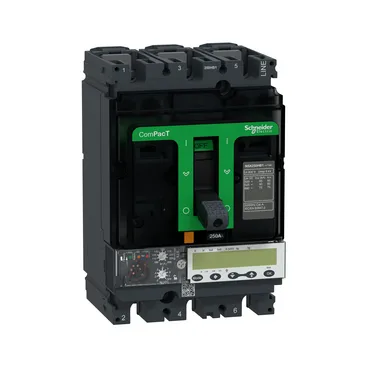
The C25V36E250 is a Schneider Electric ComPacT NSX250HB1 molded-case circuit breaker, 3-pole, rated 250 A at 40 °C. It carries an 85 kA Icu breaking capacity at 500 V AC 50/60 Hz per IEC 60947-2, which means it can safely interrupt a fault current up to that level without damage to itself or upstream gear — that's the rating that decides whether it holds on a high-fault panel or lets the arc flash through. The MicroLogic 6.2 E electronic trip unit provides four protection functions: L (long-time overload), S (short-time short-circuit), I (instantaneous short-circuit), and G (ground fault). That G function is the key difference from a standard thermal-magnetic breaker — it catches low-level ground faults that a magnetic trip might miss, which matters for equipment protection on distribution panels feeding sensitive loads.
Front connections top and bottom, which keeps wiring accessible and avoids reaching around the back. The LCD display on the trip unit shows energy metering, demand current, power quality, and time-stamped event logs — useful for commissioning and troubleshooting without needing a separate meter.
The 85 kA Icu at 500 V AC is the headline number, but the 75 kA at 690 V AC (HB1 code) is the one that governs if your system runs at higher voltage. Electrical durability is rated at 20,000 cycles at 440 V In/2, 10,000 cycles at 440 V In, and 5,000 cycles at 690 V In — so if this breaker sees frequent switching (like a motor disconnect), the 690 V figure is the endurance limit. That's a practical safety feature that a thermal-magnetic breaker doesn't have.