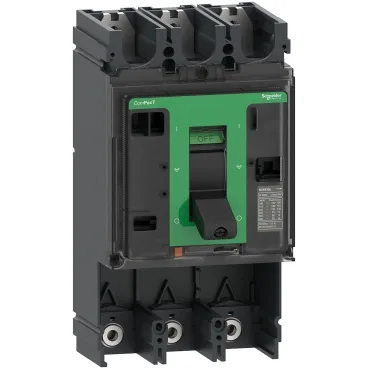
Breaking capacity — what the L code means on the bus
The L breaking-capacity code means 150 kA Icu at 380/415 V AC 50/60 Hz per IEC 60947-2. At 440 V it's still 130 kA Icu. That's high-end interrupting performance for a 400 A frame — it clears severe fault currents without cascading upstream, which matters when you're coordinating a main or tie breaker in a switchboard. The Ics (service breaking capacity) mirrors the Icu at 415 V (150 kA), so the breaker can reclose after a fault at full rating, not a derated value. That's a real advantage for uptime on a critical feeder.
Fixed-mount, backplate installation. Front connection both top and bottom. The 140 mm width, 255 mm height, and 110 mm depth fit the standard ComPacT NSX cutout. IP40 front face, IK07 impact resistance. Overvoltage category III, suitable for distribution boards downstream of the utility transformer.
Dual-listed to EN/IEC 60947-2 and UL 60947-4-1 — covers both IEC and UL installations. Suitability for isolation confirmed per EN/IEC 60947-2. Class II shock protection on the front face. Rated insulation voltage 800 V AC, impulse withstand 8 kV. Electrical durability ranges from 3,000 to 12,000 cycles depending on voltage and load; mechanical durability 15,000 cycles.