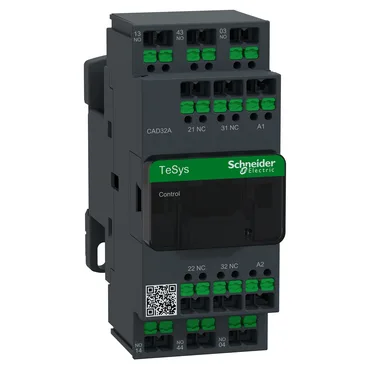
The CAD32AG7 is a TeSys Deca control relay from Schneider Electric, built for switching control circuits in industrial panels. It carries 3 normally-open and 2 normally-closed contacts, rated for operational voltages up to 690 V, with a 120 V AC standard coil. The snap-in terminal design speeds panel wiring — no screwdriver needed for the control wiring side. Rated for utilisation categories AC-15, AC-14, and DC-13 per EN/IEC 60947-5-1, so it handles solenoid loads, electromagnetic clutches, and contactor coils — the typical control-circuit inductive loads you find in a motor starter or valve manifold cabinet. The same standard set covers UL 60947-5-1, CSA C22.2 No 60947-5-1, GB/T 14048.5, and JIS C8201-5-1, which means it passes for panels destined for North America, China, or Japan without a second component review.
The relay body measures 1.8 in wide by 4.2 in tall by 3.7 in deep (45 x 107 x 93 mm), which is the standard TeSys Deca footprint — it clips onto a 35 mm DIN rail and occupies one 45 mm-wide module position. Front-face protection is IP2X per VDE 0106, meaning finger-safe from the front once installed, but the sides and back rely on the enclosure for touch protection. Operating temperature range is -40 to 140 °F (-40 to 60 °C) with derating allowed up to 158 °F (70 °C). Storage range extends from -76 to 176 °F (-60 to 80 °C). Altitude rating goes to 9842 ft (3000 m) without derating.
Mechanical endurance and sourcing posture
Mechanical robustness specs: the relay withstands 10 Gn shocks for 11 ms in the open position and 15 Gn for 11 ms closed, per IEC 60068-2-27. Vibration resistance is 2 Gn from 5 to 300 Hz open, 4 Gn closed per IEC 60068-2-6. These numbers matter if the panel is mounted on a machine frame or near a large reciprocating compressor — the relay won't chatter or drop out under those conditions.