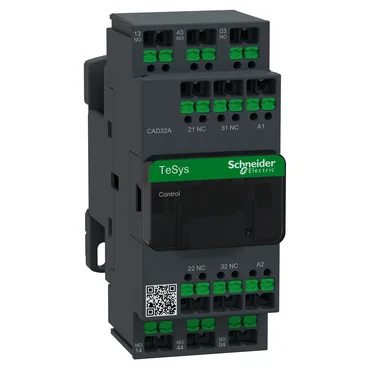
The CAD32AJ7 is a TeSys Deca control relay from Schneider Electric, configured with 3 normally-open and 2 normally-closed poles (3 NO + 2 NC). It carries a 12 V AC standard coil and is rated for control-circuit duty up to 690 V. The snap-in terminals mean it clips directly onto a DIN rail — no separate mounting base required, which keeps the kit complete for a panel-builder slotting it into a TeSys Deca assembly.
The utilisation categories tell you what loads this relay can switch: AC-15 (solenoid valves, electromagnetic clutches — inductive loads above 72 VA), AC-14 (small electromagnetic loads below 72 VA), and DC-13 (solenoids with parallel diodes). For a control-circuit relay, these are the ratings that decide whether it holds in on a contactor coil or a PLC output card's pilot duty. The 12 V AC coil is standard for older control transformers or legacy panels running 12 V control voltage. This is a panel-interior part, not a field-mounted one. Operating temperature spans -40 to 60 °C, with derating required above 60 °C up to 70 °C. Storage range is wider at -60 to 80 °C, which covers most warehouse conditions. Altitude rating goes to 3000 m without derating — fine for most installations outside high-mountain or unpressurised aircraft applications. The TH protective treatment per IEC 60068 means the relay is treated against tropical humidity; suitable for non-condensing environments in warm climates.
Standards and compliance — what the approvals cover
The CAD32AJ7 is certified to EN/IEC 60947-5-1 (control-circuit devices), UL 60947-5-1, CSA C22.2 No 60947-5-1, GB/T 14048.5 (China), and JIS C8201-5-1 (Japan). These are the key standards for control relays in industrial panels — IEC 60947-5-1 covers switching capacity, endurance, and coordination for pilot devices. The UL and CSA marks mean it is accepted for North American panel builds without additional evaluation.
Mechanical robustness — what it survives
The relay is rated for shocks of 10 Gn (11 ms) when open and 15 Gn (11 ms) when closed, per IEC 60068-2-27. Vibration resistance is 2 Gn (5–300 Hz) open and 4 Gn closed per IEC 60068-2-6. These numbers matter if the relay is mounted on a machine frame or near a large contactor bank — it will hold its state under normal industrial vibration without chattering.