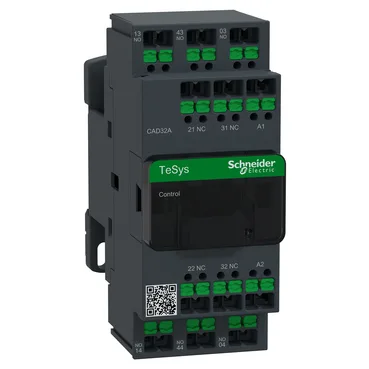
The CAD32ALE7 is a TeSys Deca control relay from Schneider Electric, built to switch control circuits in industrial panels. Its 3 NO + 2 NC pole configuration gives you three normally-open and two normally-closed contact sets in one package — enough to handle a motor starter's hold-in circuit plus a couple of status feedbacks without stacking auxiliary blocks. Rated for utilisation categories AC-15, AC-14, and DC-13, it's designed for switching electromagnetic loads like contactor coils, solenoid valves, and small DC relays — not power circuits. The 208 V AC coil is standard for North American control voltage schemes; snap-in terminals mean it clips directly onto a DIN rail without tools.
DC-13 covers DC solenoid and relay loads — useful if you're switching DC brake coils or PLC output modules. Operating temperature spans -40 to 60 °C, with derating allowed up to 70 °C. That's wide enough for an unheated enclosure in a Canadian warehouse or a panel next to a furnace line. The TH protective treatment per IEC 60068 means the relay is treated against humidity and corrosive atmospheres — not a sealed washdown part, but fine for most dry industrial environments. Mechanical robustness is specified: the relay stays closed under 15 Gn shocks and open under 10 Gn, with vibration resistance at 4 Gn closed and 2 Gn open. That's enough for a panel mounted on a vibrating conveyor or a compressor skid — you won't get nuisance dropouts from machine vibration. IP2X on the front face means finger-safe from the front, but the back and sides are open to the panel environment — standard for a DIN-rail component inside a locked enclosure.
The 45 mm width (three 9 mm modules wide) and 107 mm height let it sit on standard DIN rail alongside a TeSys D contactor or a GV2 motor breaker. No screw terminals to torque; the spring cage holds solidly once pushed in.
Compliance is broad: EN/IEC 60947-5-1, UL 60947-5-1, CSA C22.2 No 60947-5-1, GB/T 14048.5, and JIS C8201-5-1. That covers CE marking for Europe, UL listing for North America, CCC for China, and JIS for Japan — one part number clears most global panel approvals.