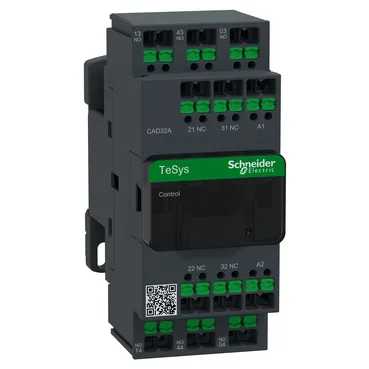
The CAD32AP7 is a TeSys Deca control relay from Schneider Electric, built for switching control circuits in industrial panels. It carries 3 normally-open and 2 normally-closed poles, with a 230 V AC standard coil, and is rated for operational voltages up to 690 V. The utilisation categories cover AC-15 (pilot duty), AC-14 (solenoid), and DC-13 (DC control loads), so it handles the typical mix of contactor coils, solenoid valves, and indicator lamps found in a control cabinet. It meets EN/IEC 60947-5-1, UL 60947-5-1, CSA C22.2 No 60947-5-1, GB/T 14048.5, and JIS C8201-5-1 — a broad set of global standards that covers most industrial installations in North America, Europe, and Asia.
The 3NO+2NC pole arrangement is a common control-relay pattern — three outputs for pilot devices or contactor coils, two NC for status feedback or safety interlocks. The snap-in terminals (listed in the description) mean it clips directly onto a DIN rail without tools, which speeds up panel assembly. Operating temperature spans -40 to 60 °C, with derating allowed up to 70 °C. Storage range of -60 to 80 °C is wider — that governs shipping and warehouse conditions, not running duty. Mechanical robustness is specified: the relay withstands 10 Gn shocks for 11 ms when open, 15 Gn when closed, and vibration from 5 to 300 Hz at 2 Gn (open) / 4 Gn (closed).
Dimensions are 45 mm wide, 107 mm high, 93 mm deep — a standard compact footprint that fits a DIN-rail enclosure without crowding adjacent devices. The IP2X front-face protection (per VDE 0106) means it's touch-safe from the front, which is the norm for panel-mounted control gear. Operating altitude is rated up to 3000 m, so it's usable in high-altitude installations without derating for air density — relevant for mining, mountain-site, or elevated plant locations. The TH protective treatment (conforming to IEC 60068) indicates it's treated for tropical humidity environments, which adds margin in non-conditioned or coastal panels.