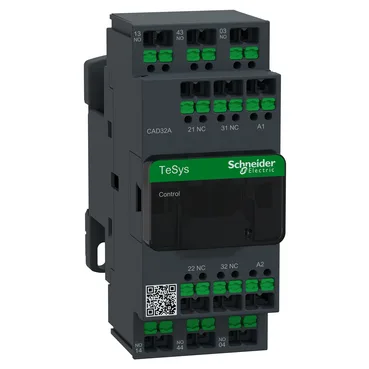
The CAD32AU7: The utilisation categories — AC-15, AC-14, and DC-13 — define the switching capability for control circuits. AC-15 covers solenoid loads (the typical contactor coil or valve), AC-14 covers electromagnetic loads with low inrush, and DC-13 covers DC solenoids. For a control relay, these are the right duty classes: they tell you the relay can switch the inductive loads found in a panel, not just resistive ones. The 3NO+2NC contact arrangement gives you three make contacts for pilot devices and two break contacts for interlocks or status feedback, which is the standard pattern for a control relay in a motor starter or safety circuit.
This is a panel-interior part, not a field-mounted device. The TH protective treatment conforming to IEC 60068 means it's treated against tropical humidity, which is useful for non-conditioned plant rooms or shipping containers.
Storage range is -60 to 80 °C. The relay withstands 10 Gn shocks for 11 ms in the open state and 15 Gn when closed, and vibration at 2 Gn (open) and 4 Gn (closed) across 5 to 300 Hz. That's solid for industrial panel vibration from contactors or drives on the same rail. Operating altitude is 0 to 3000 m — no derating needed at typical plant elevations, but above 2000 m you'd check the dielectric withstand per IEC 60947-1.