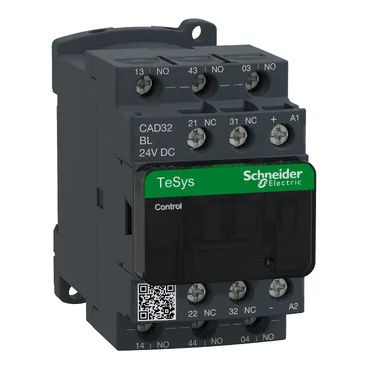
The 220 V DC low-consumption coil is the defining selection parameter here — it draws less inrush than an equivalently rated AC coil, which matters when the control transformer or DC supply is already loaded near its limit. Screw-clamp terminals on the contact block keep wiring straightforward for panel builders. This relay carries utilisation categories AC-15, AC-14, and DC-13 per IEC 60947-5-1. AC-15 covers solenoid-valve and electromagnetic-brake loads above 72 VA; AC-14 covers smaller solenoid loads below 72 VA. DC-13 is the inductive DC load category — solenoids, contactor coils — so if you are switching a DC coil bank or a valve manifold, this is the rating that governs contact life. The relay is also certified to UL 60947-5-1 and CSA C22.2 No 60947-5-1, so it passes North American panel inspections without a separate UL marking exercise.
The CAD32ML occupies a 45 mm wide footprint on the DIN rail — three modules wide in a typical 18 mm-per-module panel layout. Depth is 93 mm from the DIN rail back to the furthest terminal point, so it clears a 100 mm deep enclosure without forcing a deeper gland plate. Storage range extends to -60 to 80 °C, which is the handling and shipping limit, not the running limit. Operating altitude is rated to 3000 m; above that, air density affects dielectric withstand and cooling, so the relay should be derated per IEC 60947-1. IP2X finger protection per VDE 0106 means the live parts are guarded against accidental contact but the relay is not sealed — it belongs in a clean, dry enclosure, not a washdown zone. Protective treatment is TH per IEC 60068, which is a tropical-heat classification: the relay is treated against humidity and fungal growth, so it holds up in non-condensing environments up to 95% RH.