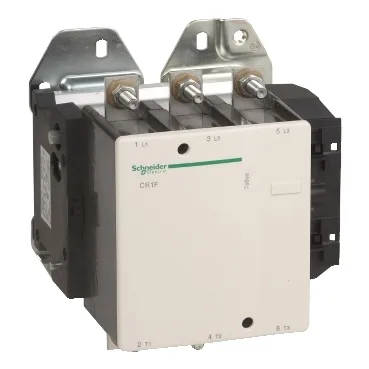
It's rated for control applications across AC-1 (resistive), AC-3 (motor start/run), and AC-4 (plugging, inching, reversing) duty classes, so the same part covers a wide range of load types in a panel. The headline number is 400 A rated operational current in AC-4 duty at ≤ 440 V, but what that means for a motor load is better read from the power table: 185 kW at 1000 V AC, 280 kW at 690 V, 250 kW at 440 V, 220 kW at 415 V, 200 kW at 380–400 V, and 110 kW at 220–230 V — all at 50/60 Hz. For UL/CSA installations, the horsepower ratings are 300 hp at 575–600 V, 250 hp at 460–480 V, 125 hp at 220–240 V, and 100 hp at 200–208 V, three-phase. That's the range a site electrical engineer uses to confirm the contactor fits the motor nameplate. Because it's a latching contactor, the coil only draws power during the switching event — 1600 VA for latching, 16 VA for unlatching, on both AC (50–400 Hz) and DC control supplies. The control circuit voltage is 208 V AC or DC standard, with a tolerance band of 0.85 to 1.1 Uc for both latching and unlatching. Operating time is 40–75 ms to latch, 50–100 ms to unlatch.
Power connections accept lugs or ring terminals up to 150 mm² (2 x 0.2 in²) or bars 2 x 30 x 5 mm. Tightening torque is 309.8 lbf·in (35 N·m) — that's a serious torque, so a calibrated torque wrench is part of the install kit. The associated fuse ratings for the power circuit are 400 A aM, 500 A BS88, or 500 A gG at ≤ 440 V, which gives the panel builder a coordination starting point for the upstream protection.
Breaking capacity and durability
Rated breaking capacity varies by voltage: 4000 A at 220–440 V, 3500 A at 500 V, 3000 A at 660/690 V, and 1200 A at 1000 V — all for the power circuit. The rated making capacity is 4500 A. These numbers tell a commissioning engineer what fault level the contactor can interrupt without welding its main poles, which matters when coordinating with upstream breakers or fuses in a selective scheme. Power dissipation per pole is 45 W in AC-3 duty and 70 W in AC-1 — that heat has to leave the enclosure, so factor it into the panel's thermal budget. Average impedance is 0.28 mΩ at Ith 500 A, 50 Hz.
Standards compliance covers NF C 63-110, BS 5424, JEM 1038, IEC 60947-4, and VDE 0660 — so it's accepted across European and Japanese regulatory frameworks. The protective treatment is TH (tropicalized), which adds corrosion resistance for humid environments. Operating altitude is 3000 m without derating; ambient operating temperature range is -15 to 70 °C.