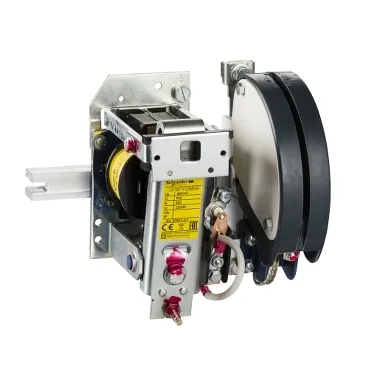
The Schneider Electric CV3BF2F0ZM522 is a TeSys B contactor, a 2-pole unit rated for 80 A operational current (Ie) on the control circuit, with a 220 V AC 50 Hz coil. It's built for switching resistive and motor loads under AC-1 and AC-3 utilisation categories respectively, meaning it handles both heating/lighting circuits and squirrel-cage motor starting and stopping. The 1000 V rated insulation voltage (Ui) and compliance with EN/IEC 60947-4 give it the clearance for 690 V line work common in industrial panels.
The 80 A Ie at 220 V AC is the continuous current the main poles carry in normal service. For motor duty (AC-3), that 80 A rating governs the full-load current of the motor it can switch — a 37 kW motor at 400 V typically draws around 70 A, so this contactor has headroom. The AC-1 rating (resistive) is the same 80 A, so it's not derated for heating loads. The 2 NO main pole configuration means it switches both lines in a single-phase or DC circuit, or one phase of a three-phase system if you're paralleling poles for higher current. The IP00 protection rating means it's a panel-mount part — no enclosure, so it needs a cabinet or enclosure to keep out dust and accidental contact.
Coil and control circuit details
The coil pulls 270 VA inrush at 50 Hz and holds at 45 VA. Operating limits are 0.85 to 1.1 Uc (187 to 242 V AC) at 50 Hz; dropout happens between 0.5 and 0.7 Uc (110 to 154 V AC). That's a standard AC coil curve — the dropout margin is generous, so it won't chatter on a sagging line. The contactor closes in 40 ms and opens in 15 ms, which is fast enough for general motor starting but not for high-speed synchronisation. The control circuit has its own fuse recommendation: 80 A aM or 125 A gG at up to 400 V. The average impedance per pole is 1.5 mOhm at 80 A, 50 Hz, so power dissipation runs 9.6 W per pole in both AC-1 and AC-3 duty.
Integration notes
The contactor has 2 NO + 2 NC instantaneous auxiliary contacts built in, which saves an add-on block for basic status feedback or interlocking. Power circuit connections are bolted, accepting cable with lugs up to 25 mm². Control circuit terminals accept 1 to 6 mm² wire (with or without cable end). Tightening torque for the power circuit is 9 N·m; control circuit is 1.2 N·m. Maximum operating rate is 120 cycles per minute at 55 °C. Mechanical durability is 5 million cycles — that's a long service life for a panel that cycles a few times per hour.