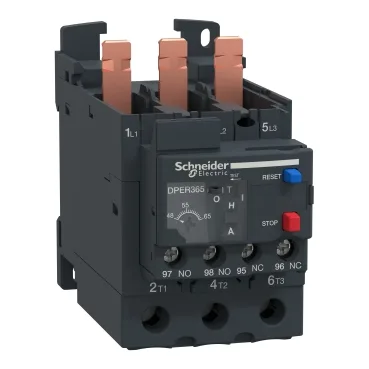
Schneider Electric DPER365 — Overload Relays

Schneider Electric DPER365 Easy TeSys Differential Thermal O

MPNDPER365
Active

Schneider Electric Easy TeSys DPER, differential thermal overload relay, DPER365, 48-65 A adjustment range, Class 10, 1 NO + 1 NC, IP20.

$75.00Ref. price · indicative, final on quote
Sourced new & surplus through independent channelsAuthenticity-screened · ESD-safe packingListing updated Aug 2026

Specifications

DPER365 — Environmental
ParameterValue
Shock resistance15 gn 11 ms IEC 60068-2-7
DPER365 — Mechanical
ParameterValue
Width2.2 in (55 mm)
Height2.8 in (70 mm)
Depth4.8 in (123 mm)

Product details

Its 48-65 A thermal protection adjustment range means it directly protects motors with a full-load current in that band — the relay is set to the motor nameplate FLA, and the Class 10 trip curve ensures it clears a stall before the motor insulation degrades, which is the standard for standard-duty induction motors like pumps and fans. The 1 NO + 1 NC auxiliary contact composition gives one normally-open signal for a PLC input (run indication) and one normally-closed for the safety chain (trip alarm), which is the conventional wiring for a motor starter.

Standards and deployment context

IEC 60947-4-1 is the standard for contactors and motor-starters; IEC 60947-5-1 covers control-circuit devices. This means the relay is accepted for use in IEC and UL 508A panels worldwide. The phase failure sensitivity — tripping at 130% of Ir on two phases with the third at zero — catches a lost phase before the motor single-phases and burns out, which is the critical protection for three-phase motor loads on a line. Mounting support is plate, rail, or under contactor, so it fits the standard DIN-rail footprint in a panel or directly on the contactor body for a compact starter assembly.

Frequently asked questions

What is the thermal protection adjustment range?

The adjustment range is 48-65 A. Set it to the motor's full-load amperage within that band.

What auxiliary contacts does it have?

It has 1 normally-open and 1 normally-closed contact. The NO contact is typically used for a run signal to a PLC; the NC contact for a trip alarm in the safety circuit.

What standards does it comply with?

It complies with EN/IEC 60947-4-1, EN/IEC 60947-5-1, UL 60947-4-1, UL 60947-5-1, and CSA C22.2 No 60947-4-1 and No 60947-5-1. This covers motor-starter and control-circuit device standards for IEC, UL, and CSA jurisdictions.

What is the trip class?

It is Class 10 per IEC 60947-4-1. This means the relay will trip within 10 seconds at 7.2x the current setting, suitable for standard induction motors.

MPN
DPER365