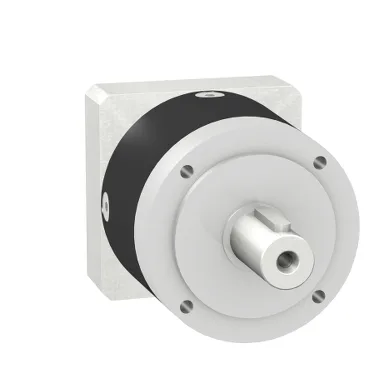
The GBX0600600703F is a 60 mm-diameter planetary gearbox with straight-cut teeth, delivering a 60:1 reduction ratio. The continuous output torque is 44 N.m at 100 rpm and 30 °C ambient — this is the thermal limit for sustained duty, not the peak the gear train can survive momentarily. Efficiency is listed at 94 %, which is typical for a single-stage planetary at this ratio. The 6 % loss shows up as heat in the gear mesh and bearings; at 44 N.m continuous output, the thermal dissipation is about 2.8 W — well within the aluminium housing's natural convection capability.
Load ratings and service life — the real constraints for a sizing engineer
Rated service life is 30,000 hours at 100 rpm and 30 °C with the continuous torque of 44 N.m. The maximum output torque is 70 N.m at the same speed and temperature — this is the peak the gearbox can handle without immediate damage, but running at that level shortens life below the 30,000-hour target. Maximum radial force on the output shaft is 340 N at mid-shaft for the 30,000-hour life target, or 500 N for a 10,000-hour duty cycle. Maximum axial force is 450 N for 30,000 hours, 600 N for 10,000 hours. Both figures assume 100 rpm and 30 °C — derate for higher speeds or temperatures. Torsional rigidity is 2.5 N.m/arcmin, and maximum torsional backlash is 22 arc.min. The 22 arc.min figure is the total lost motion across the gear train — for positioning applications requiring less than 0.37° of windup at rated torque, this gearbox is not the right choice; a low-backlash or zero-backlash planetary would be needed.
Obsolete — sourcing reality for a line-down or BOM-fill situation
Schneider Electric lists the GBX0600600703F as obsolete. The gearbox is lubricated for life and sealed to IP54 at the shaft output — no maintenance ports or regrease intervals. The housing is black anodized aluminium, shaft material is C45 steel. Ambient operating range is -25 to 90 °C.