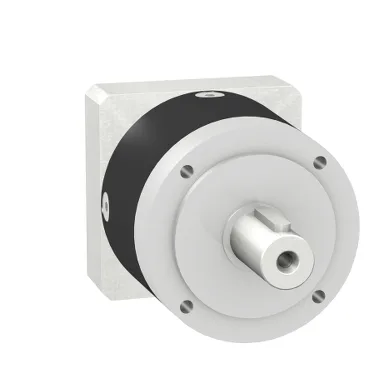
Planetary gearbox, 80 mm frame, 15:1 — torque and duty cycle
The GBX0800151003F is a straight-tooth planetary gearbox in the 80 mm diameter frame, delivering a 15:1 reduction ratio. Continuous output torque is 110 N.m at 100 rpm and 30 °C, with a maximum intermittent rating of 176 N.m at the same speed and temperature — that 60 % headroom covers acceleration peaks and short overloads without exceeding the 30000-hour service life target. Efficiency is listed at 94 %, which is typical for a single-stage planetary of this size. The noise floor at 60 dB (1 m, no-load) is quiet enough for indoor conveyor or packaging lines where operator exposure is a concern.
Mounting and environmental fit
The housing is black anodized aluminium, 80 mm outside diameter, with a C45 steel output shaft. Shaft output sealing is rated IP54 — fine for dry indoor environments but not for washdown zones. The gearbox is lubricated for life, so no maintenance interval for oil changes. Ambient operating range is -25 to 90 °C, which covers most heated factory floors but not freezer applications. Maximum axial (Fa) and radial (Fr) forces are derated with service life: at 30000 hours and 100 rpm, Fa is 900 N and Fr is 650 N applied at mid-span on the output shaft.
Backlash and torsional stiffness
Maximum torsional backlash is 14 arcmin — that is a standard-precision planetary, not a zero-backlash servo gearhead. For indexing or positioning applications where reversal error matters, this level of backlash means the output shaft can rotate up to 14 arcminutes before the input engages in the opposite direction. Torsional rigidity is 6.5 N.m/arcmin, so the wind-up under rated load is predictable.
Obsolete — sourcing through independent channels
Schneider Electric lists the GBX0800151003F as obsolete. The gearbox is available through independent surplus and broker channels — quantities are lot-specific and confirmed at RFQ. This is a straight-tooth planetary with a 15:1 ratio and 80 mm frame; if you are replacing one on a legacy machine, the bolt pattern and shaft dimensions should be verified against the original installation.