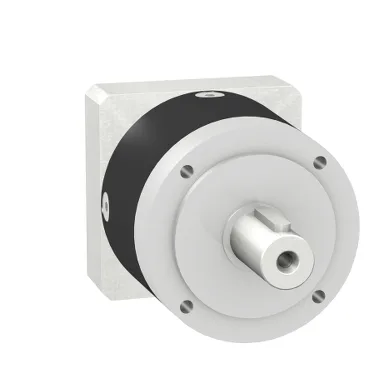
Obsolete — sourcing through independent channels
The GBX1200050551F: Available through independent surplus and broker channels.
Torque and duty ratings that govern the fit
Continuous output torque is 195 N.m at 100 rpm and 30 °C ambient — this is the sustained load the gearbox can carry across its 30,000-hour service life without exceeding thermal limits. Maximum output torque reaches 312 N.m under the same conditions, but this is a peak rating for intermittent overloads, not continuous duty. Torsional rigidity is 12 N.m/arcmin, meaning the gearbox resists wind-up under load — relevant for positioning accuracy in indexing or servo-feed applications. Maximum torsional backlash is 8 arc.min, which defines the lost motion at the output shaft when reversing direction. For precision positioning, this figure must be within the system's allowable error budget.
Mechanical interface and environmental limits
Gearbox external diameter is 120 mm — this sets the mounting envelope and the clearance needed in the machine frame or bracket. Shaft output is rated IP54, meaning the output seal resists dust ingress and splashing water but is not submersible. The housing itself is black anodized aluminium. Maximum axial force Fa is 2100 N at 100 rpm for the full 30,000-hour life, or 2800 N if the life target is reduced to 10,000 hours. Radial force Fr is 1500 N at mid-span for 30,000 hours, or 2000 N for 10,000 hours. These force limits govern the overhung load the output shaft can support from a belt, chain, or direct-coupled load. Ambient temperature range for operation is -25 °C to 90 °C. The gearbox is lubricated for life — no field re-greasing interval.
Efficiency and noise — what the numbers mean
Efficiency is listed at 94 %. This is the ratio of output mechanical power to input mechanical power at rated load and speed. The 6 % loss is dissipated as heat within the gearbox housing and must be considered in the thermal design of the driven system. Noise level is 65 dB at 1 m, no-load. This is a free-field measurement — in a machine enclosure or panel, the perceived noise may be lower due to absorption or higher due to structure-borne resonance. Straight-cut teeth (as opposed to helical) typically produce more gear whine at higher speeds.