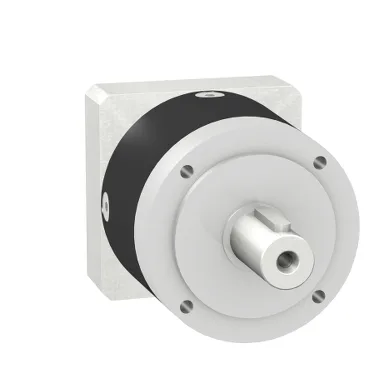
Planetary gearbox, 120 mm, 5:1 — what the torque ratings mean
The GBX1200050552F is a straight-tooth planetary gearbox in a 120 mm diameter housing, black anodized aluminium, with a C45 steel output shaft. The 5:1 reduction ratio is fixed — this is a single-stage unit, not a multi-stage configurable box. Continuous output torque is 195 N.m at 100 rpm and 30 °C ambient. Maximum output torque hits 312 N.m under the same conditions — that's the peak the gear train can handle before the teeth yield, not a continuous operating point. Torsional rigidity is 12 N.m/arcmin, and maximum backlash is 8 arc.min. The rigidity number tells you how much the output shaft twists under load — 12 N.m per arcminute means a 120 N.m load produces about 10 arcmin of wind-up, which matters for positioning accuracy in a pick-and-place or indexing axis.
Obsolete — sourcing reality for this gearbox
Schneider Electric lists this gearbox as obsolete. The GBX series has been replaced by newer planetary families with different frame sizes and mounting patterns — a direct bolt-in replacement is unlikely without a shaft alignment check. Available through independent surplus and new-old-stock channels. Quantities are confirmed at RFQ; no stock-holding claim is made here. The lubricated-for-life design means shelf-stored units retain their grease charge — no re-lube required before commissioning as long as the shaft seals are intact. Service life is rated at 30,000 hours at 100 rpm and 30 °C. That's about 3.4 years of continuous operation at rated speed and torque. Running at higher output torque or temperature derates that figure — the 10,000-hour axial and radial force ratings (2800 N axial, 2000 N radial) are the accelerated-life limits.
Shaft loads, IP rating, and temperature envelope
Maximum axial force Fa is 2100 N for the full 30,000-hour life at 100 rpm, or 2800 N for a 10,000-hour application. Radial force Fr at mid-shaft is 1500 N for 30,000 hours, 2000 N for 10,000 hours. These are the limits on overhung loads from pulleys, sprockets, or direct-coupled masses — exceed them and the bearings wear out before the gear teeth. The housing itself is sealed, but the output shaft lip seal is the wet-end boundary. Ambient operating range is -25 to 90 °C. The lubricant is factory-filled for life, so there is no oil-change interval. At the low end, the grease stiffens and starting torque increases — budget for that in the motor sizing if the gearbox sees cold starts.
Efficiency and noise — what the numbers tell you
Efficiency is listed at 94 %. For a single-stage planetary, that's typical — the power loss is about 6 % through the gear mesh and bearings. At 195 N.m continuous output, the input power needed is roughly 2.2 kW at 100 rpm output speed, accounting for the loss. Noise level is 65 dB at 1 m, no-load. That's about the level of a quiet office conversation — the straight-tooth cut is noisier than helical, but the planetary arrangement distributes the mesh load across multiple planet gears, which keeps the whine down. Under load, expect a few dB more from tooth deflection.