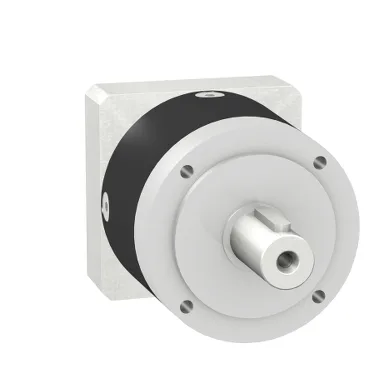
Torque ratings and the real duty cycle
The GBX1200050553F is a 120 mm planetary gearbox with a 5:1 reduction ratio, sized for applications where the continuous output torque is 195 N.m at 100 rpm — that's the number to design around for steady-state loads like conveyors or rotary indexing tables. Maximum output torque hits 312 N.m at the same speed, but that's the short-duration peak for acceleration or occasional overload — the 30000-hour service life rating applies at the continuous torque figure, not the peak.
Backlash, stiffness, and positioning limits
Maximum torsional backlash is 8 arc.min, and torsional rigidity is 12 N.m/arcmin — together these set the repeatability floor for positioning. For a pick-and-place or cam-indexing axis, that 8 arc.min at the output means the load position uncertainty is about 0.13° at the gearbox shaft before any belt or coupling compliance. Straight-tooth planetary design gives higher torque density than helical for the same diameter, but the noise floor is higher — 65 dB at 1 m no-load is the baseline; expect a few dB more under full torque.
Sourcing this obsolete gearbox
The 94 % efficiency means the thermal loss at 195 N.m and 100 rpm is about 1.3 kW — that heat has to go through the anodized aluminium housing. The IP54 shaft output seal handles incidental splash but not washdown; the housing itself is not sealed.
Shaft loading limits for belt and pulley drives
Maximum radial force Fr is 1500 N at 100 rpm for the full 30000-hour life, applied at mid-distance from the output shaft. If the application needs a shorter life — 10000 hours — that radial limit rises to 2000 N. Axial force Fa is 2100 N at the same 30000-hour condition, stepping to 2800 N for 10000 hours. The C 45 steel output shaft and lubricated-for-life grease pack mean no maintenance re-greasing schedule, but the operating temperature range of -25 to 90 °C sets the grease viscosity window — below -25 °C the starting torque climbs noticeably.