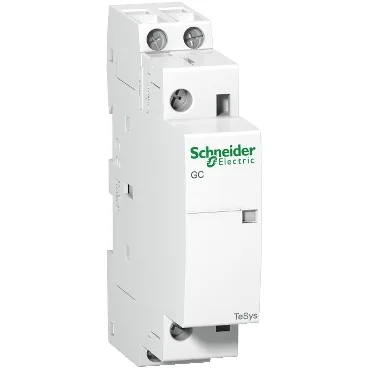
Rated breaking capacity is 40 A at 400 V per IEC 61095, and the rated making capacity matches at 40 A. Electrical durability is 100,000 cycles under both AC-7A and AC-7B duty, with mechanical durability at 1,000,000 cycles. The white housing and screw-clamp terminals accept up to 6 mm² for the power circuit.
The AC-7A and AC-7B ratings are the key selection criteria. AC-7A covers resistive loads (heating) and AC-7B covers motor loads up to the contactor's rated current. For a 2-pole contactor on a single-phase motor or a resistive heater bank, this is the right duty class. The control coil draws 15 VA inrush at 20 °C and dissipates 1.3 W at 50/60 Hz. Drop-out voltage is 0.2 to 0.75 Uc, so the coil releases reliably on a sagging control supply. IP20 protection (fingers) per VDE 0106, and IP40 when mounted in an enclosure. The associated fuse rating is 16 A gL at ≤ 440 V for the power circuit.
The 17.5 mm width means it takes one 18 mm module position in a distribution board. Screw-clamp terminals on both control and power circuits; torque to 0.8 N·m. The control circuit accepts up to 2.5 mm² flexible without cable end, and the power circuit accepts up to 6 mm². Operating position is 30° from vertical, so it can be mounted on a slight angle if needed. The contactor is rated for 300 cycles per hour at 50 °C. Standards compliance includes IEC 61095 (household and similar electromechanical contactors) and IEC 60947-5 (control circuit devices). Insulation voltage is 500 V per both standards.