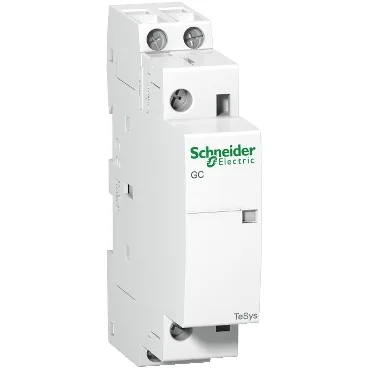
The contactor clips onto a standard DIN rail, occupying a single 18 mm module width, which keeps panel layout dense and predictable for a 2-pole device.
The 48 V AC 50 Hz coil pulls 15 VA inrush at 20 °C and dissipates 1.3 W holding power — a modest draw that a small control transformer can support, but the drop-out threshold of 0.2...0.75 Uc means the coil releases reliably even on a sagging line, which matters for undervoltage protection schemes. Electrical durability is 100,000 cycles for both AC-7A and AC-7B duty; mechanical durability is 1,000,000 cycles. For a lighting or small-motor application cycling a few times per hour, that translates to years of service before a planned replacement. Operating time is 10...25 ms opening and 10...30 ms closing — fast enough for most switching sequences, but not a high-speed transfer switch. The maximum operating rate is 300 cycles per hour at 50 °C.
The 17.5 mm width and 81 mm height let it slot into a standard 18 mm DIN-rail grid alongside other TeSys GC modular devices — breakers, timers, auxiliary contact blocks — without wasting rail space. Screw-clamp terminals on both control and power circuits accept up to 6 mm² solid or flexible cable on the power side, which is adequate for the 25 A fuse rating. Torque to 0.8 N·m on all terminals.