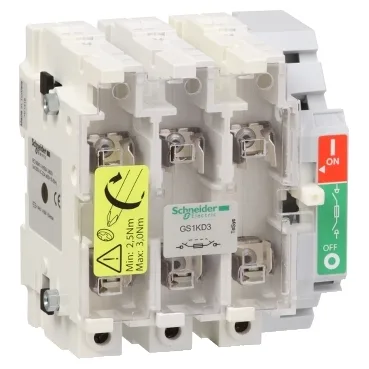
125 A Switch-Disconnector-Fuse for Motor Branch Circuits
The GS1KD3 is a TeSys GS switch-disconnector-fuse, rated 125 A at 400 V in AC-23A/B duty — that's the heavy motor-switching category, so it handles the inrush and breaking of motor loads directly without derating. Three protected poles (3t) with a direct right-side operating handle; the 22 x 58 mm fuse accommodation means it accepts standard NH-type fuse links for short-circuit protection up to 20 kA withstand. Rated operational power reaches 63 kW at 400 V and 90 kW at 690 V — the voltage step tells you the current-limiting factor is the fuse, not the switch body.
Breaking Capacity and Coordination Reality
Making capacity is 1250 A at 400 V AC-23B; breaking capacity is 1000 A at the same condition — these are the numbers the upstream protection device needs to see for selective coordination. Short-circuit making capacity [Icm] hits 100 kA at 400 V when backed by gG fuses — the switch itself is a disconnector, not a breaker, so the fuse does the interrupting; the switch just has to close onto the fault and hold. Rated impulse withstand voltage [Uimp] is 8 kV, which covers the transient overvoltage category IV for industrial distribution panels per IEC 60947-3.
Mounting, Wiring, and Environment
Mounts on a plate (not DIN rail directly) — the 6.4 in (162 mm) height and 5.9 in (150 mm) width fit standard backplate layouts; depth is 4.6 in (116 mm) including the handle throw. Power circuit terminals accept bars or lugs/ring terminals for 35...95 mm² flexible copper — the 12 N·m torque spec is high, so use a torque wrench; under-torquing here is the most common cause of thermal runaway on high-current fused switches. IP20 with the terminal cover fitted — that's finger-safe, not washdown; the TH protective treatment means it's tropicalized for humidity, but keep it in a panel if there's condensation risk.
Lifecycle and Sourcing Position
No official successor or cross-reference to a different order code exists — the GS1KD3 is the current offering in the TeSys GS range for this ampacity and pole count.