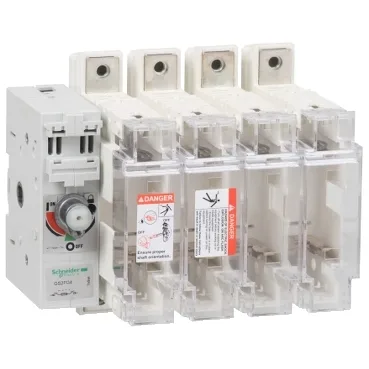
The Schneider Electric GS2FG4 is a TeSys GS switch-disconnector-fuse — a 4-pole unit rated for 50 A continuous (Ith 50 A at 40 °C) and built to IEC 60947-3. It uses NFC-type fuses in the 14 x 51 mm size, so the fuse carrier is the interrupting element; the switch itself provides isolation and fault making/breaking. For motor circuits, the rated operational power is 25 kW at 400 V, 33 kW at 500 V, and 45 kW at 690 V — that covers a solid range of three-phase induction motors on standard European voltages.
The headline 50 A rating is the AC-23A/AC-23B current at 400 V and 500 V — that's the motor-switching duty class, so the 50 A holds for both resistive and inductive loads up to those voltages. The making capacity of 500 A at 400 V AC-23B tells you it can close onto a stalled motor or shorted load without welding contacts. Short-circuit withstand is 10.6 kA, and with gG fuses the rated short-circuit making capacity jumps to 100 kA at 400 V — that's the coordination you need for a high-fault panel. The 8 kV impulse withstand voltage (Uimp) and 750 V rated insulation voltage (Ui) give headroom for 690 V systems. Electrical durability is 300 cycles under AC-23B and 1500 under AC-23A — that's typical for a fuse-switch; the mechanical durability of 10 000 cycles is the handle life, not the fuse life.
This is a plate-mounted unit — no DIN-rail clip, so plan for a backplate or sub-panel with the 148 x 118 mm footprint and 87 mm depth. The external left-side operating handle means the switch sticks out to the left of the enclosure cutout; factor that into door layout. Terminals accept lugs or ring terminals from 6 to 25 mm², torqued to 3.2 N·m on the power circuit. IP20 with the terminal cover fitted — fine inside a locked cabinet, not for washdown zones.