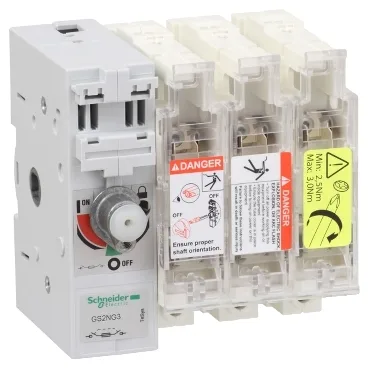
The GS2NG3 is a TeSys GS switch-disconnector-fuse, a 3-pole unit rated for 250 A continuous (conventional free-air thermal current Ith at 40 °C). It's designed to provide visible isolation and fuse protection in a single package, per IEC 60947-3. The 250 A rating holds across AC-23A and AC-23B duty at 400 V, 500 V, and 690 V, meaning it handles motor switching and mixed loads up to that current. Breaking capacity is 2000 A at 400 V under AC-23B, and making capacity is 2500 A at the same condition — so it can close onto a fault within that range without welding contacts. Rated operational power reaches 132 kW at 400 V, 160 kW at 500 V, and 220 kW at 690 V, which maps it to larger motor or distribution loads in a panel. Short-circuit withstand is 32.5 kA, and with gG fuse backup the rated short-circuit making capacity hits 80 kA at 400 V — the fuse does the heavy interrupting, the disconnector isolates.
Mounts to a plate — not DIN rail — so factor in the backplate footprint: 234 mm wide, 195 mm tall, 146 mm deep. The operating handle is on the external left side. Power circuit connections accept bars up to 32 mm² or lugs/ring terminals from 95 to 240 mm², torqued to 25 N·m. Fuse size is DIN 1, 3 protected poles (3t). IP20 with the terminal cover fitted, so it's for inside a locked enclosure, not washdown areas.
Durability and environment
Mechanical durability is 10,000 cycles; electrical durability is 1,000 cycles under AC-23A or AC-23B, and 200 cycles under DC-23A or DC-23B. That's typical for a switch-disconnector — it's not a daily-use contactor. Fire resistance: the fuse cover withstands 850 °C and the body 960 °C per IEC 60695-2-1. Rated insulation voltage Ui is 750 V AC, and impulse withstand Uimp is 8 kV.