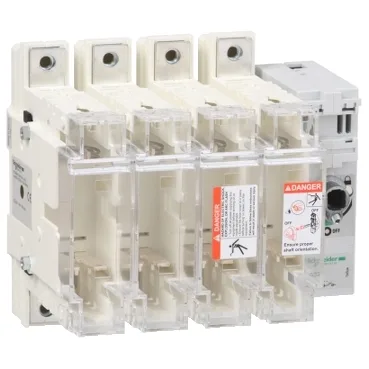
The Schneider Electric GS2N4 is a TeSys GS switch-disconnector-fuse, a 4-pole unit rated for 250 A at 400 V AC in both AC-23A and AC-23B duty classes — meaning it handles motor switching and mixed resistive-inductive loads up to that current, not just resistive heating. Built to IEC 60947-3, it offers a making capacity of 2500 A and a breaking capacity of 2000 A at 400 V AC-23B, so it can close onto and interrupt fault currents well above its continuous rating — a key spec for coordination studies in distribution panels. Rated operational power reaches 132 kW at 400 V, 160 kW at 500 V, and 220 kW at 690 V, making it a fit for motor branch circuits and feeder disconnects in industrial power distribution.
The 250 A conventional free-air thermal current (Ith at 40 °C) is the baseline for continuous duty; the AC-23A/B ratings at 400/500/690 V confirm it switches motor loads without derating across common industrial voltage levels. Short-circuit withstand rating of 32.5 kA and a making capacity of 100 kA at 400 V (with gG fuse backup) tell you this unit can survive a fault long enough for upstream protection to clear — critical for selective coordination in a main switchboard. Power circuit terminals accept bars up to 32 mm² or lugs/ring terminals from 95 to 240 mm², sized for the 250 A feed; tightening torque is 25 N·m on the power connections.
Plate-mount design (294 mm wide, 195 mm high, 146 mm deep) with an external frontal or right-side operating handle — typical for panel-door interlocked disconnect applications where you need a visible break and local lockout capability. Accepts DIN-type fuses, size 1, protecting all 4 poles (4t protected poles). The 850 °C / 960 °C fire resistance on the fuse cover and body meets IEC 60695-2-1, a safety requirement for enclosed switchgear. Rated insulation voltage (Ui) is 750 V AC, and impulse withstand (Uimp) is 8 kV — adequate for 400/690 V systems with typical surge exposure.