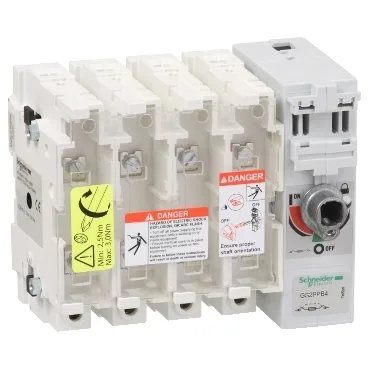
It accepts BS-type fuses in sizes B1, B2, or B3 — a common standard in UK and Commonwealth installations — and is built to IEC 60947-3, the standard for disconnectors and switch-disconnectors. The 315 A AC-23A rating at 400 V means it handles motor switching with occasional overloads, while the 40 kA short-circuit withstand (SCCR) ensures it can survive a fault without rupturing, provided upstream protection is coordinated. Breaking capacity is 2520 A at 400 V under AC-23B duty, and making capacity reaches 3150 A at the same voltage — figures that govern its ability to close onto a fault or interrupt a stalled motor circuit.
Rated operational current spans multiple duty classes: 315 A in AC-23A and AC-23B at 400 V, 315 A at 500 V, and 250 A at 690 V AC-23A. For DC circuits with two poles in series per phase, it carries 200 A at 440 V DC-23A/DC-23B. The 40 kA SCCR with appropriate upstream fuses means it can be installed in high-fault-capacity panels without requiring a current-limiting upstream breaker. Mechanical durability is 10,000 cycles; electrical durability is 1,000 cycles under AC-23A or AC-23B, and 200 cycles under DC-23A or DC-23B. These are not high-cycle numbers — the part is intended for infrequent manual or motorized switching, not for repeated daily operation.
Mounting and connection
Mounts on a plate (not DIN rail). The power circuit accepts bars up to 45 mm² or lugs/ring terminals from 185 to 240 mm² — sized for the 315 A rating. Tightening torque for the power connections is 25 N·m. The operating handle can be mounted externally on the right side or on the front, giving flexibility for panel door cutouts. Dimensions are 318 mm wide, 205 mm high, and 149 mm deep — allow clearance for handle swing and cable bending radius.