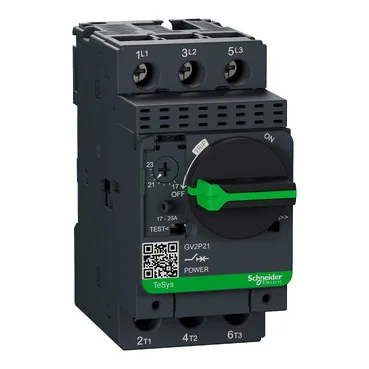
Its 23 A rated current (In) sets the overload threshold for a connected motor, and the magnetic trip fires at 341 A for short-circuit protection.
The 45 mm width and 89 mm height keep it compact for a 23 A motor-protection device — three of these side by side take 135 mm of DIN rail. Screw-clamp terminals accept up to 2 x 6 mm² solid or 2 x 4 mm² flexible with ferrule, torqued to 1.7 N·m. The rotary handle gives a clear on/off/ trip indication; IP20 finger-safe terminals are standard for inside-panel use.
The headline numbers that govern selection: 23 A In for the motor FLA, 9 kW at 400/415 V three-phase (11 kW at 500 V, 18.5 kW at 690 V). Breaking capacity drops as voltage rises — 100 kA at 230 V, 50 kA at 400 V, 20 kA at 440 V, 10 kA at 500 V, 4 kA at 690 V — so check the available fault current at your installation voltage. Utilisation category AC-3 (and AC-3e) means it's rated for starting and disconnecting squirrel-cage motors under load; Category A per IEC 60947-2 covers the short-circuit making and breaking. Electrical durability is 100,000 cycles at 415 V at rated current — that's the life you can expect in normal motor-switching service before the contacts need replacing.
Certified to EN/IEC 60947-2 (circuit-breaker standard) and EN/IEC 60947-4-1 (contactor/motor-starter standard), plus UL 60947-4-1 and CSA C22.2 No 60947-4-1 for North American installations. Also listed to IEC/EN 60335-2-40 Annex JJ and IEC/EN 60335-1 Clause 30.2 for glow-wire / fire resistance (960 °C per IEC 60695-2-11). Climatic withstand per IACS covers marine and humid environments. Operating altitude limited to 2000 m without derating.