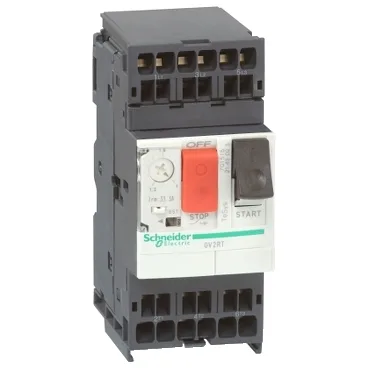
It uses a thermal-magnetic trip unit — the thermal element handles overloads, the magnetic element handles short circuits — and is sized for the smallest fractional-horsepower motors: 0.06 kW at 230 V, 0.09 kW at 400 V, 0.12 kW at 440 V. The 100 kA rating holds across the full voltage range up to 690 V — that is unusually high for a 0.4 A breaker and means it is safe on high-SCCR installations. The electrical durability is 100,000 cycles at 415 V in AC-3, so it is not a one-shot device — it lives through repeated starts in a production line.
How it mounts and connects
At 45 mm wide it takes one standard 9 mm pitch on the rail, leaving room alongside contactors or other breakers. Spring-clamp terminals accept 1 to 6 mm² solid or 1.5 to 4 mm² flexible with ferrules — no screwdriver torque check needed, which speeds up wiring on a panel build. Mounts horizontally or vertically. The toggle control is manual, so it is a local disconnect — no remote trip coil.
Thermal protection adjustment range: 0.25 to 0.4 A — you set the overload threshold within that window to match the motor full-load current. Magnetic trip fixed at 8 A, which is 20 times the rated current, so it avoids nuisance trips on inrush. Breaking capacity: 100 kA Icu at 230 V, 400 V, 440 V, 500 V, and 690 V — the full range. That is a category A breaker (no intentional short-time delay) per IEC 60947-2, so it clears faults fast without waiting for downstream devices. Power dissipation per pole: 2.5 W. Ambient operating range: -20 to 60 °C. Storage: -40 to 80 °C. IP20 finger-safe terminals, IK04 impact resistance. Climatic withstand per IACS for marine or humid environments.