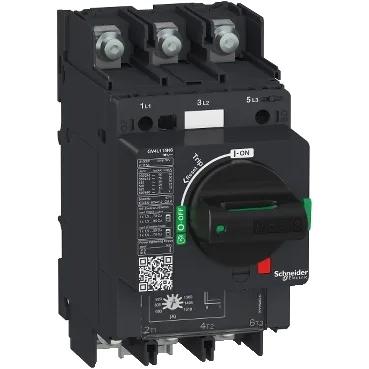
It combines magnetic and electronic trip technology for overload and short-circuit protection of motors up to 37 kW at 400 V AC. Rated for AC-3 utilisation category per IEC 60947-4-1, meaning it's built to switch motor loads under full load and handle the inrush without nuisance tripping. The 80 A In covers a solid range of medium-horsepower motors — think conveyors, pumps, compressors in a 400 V panel. Breaking capacity hits 100 kA Icu at 240 V AC per IEC 60947-2, dropping to 50 kA at 400 V and 8 kA at 690 V. That 50 kA at 400 V gives real headroom for high-fault installations; you can coordinate this downstream of a larger feeder without worrying about cascading failure.
The TeSys GV4 family is the successor to the older GV2 and GV3 ranges, offering higher breaking capacities and electronic trip adjustability. If you're migrating from a GV2ME or GV3P, the GV4L80N6 is the direct replacement — same DIN-rail footprint, same rotary-handle interface.
Mounts on DIN rail, three-pole format, 81 mm wide by 155 mm tall by 165 mm deep. That 165 mm depth is the key dimension for shallow enclosures — verify gland plate clearance before routing cables. Terminals accept lug-ring connections: 9 N·m torque for 16–95 mm² cable, 5 N·m for 1.5–10 mm². The 27 mm connection pitch (35 mm with spreaders) matches standard busbar systems. IP40 front face, IK07 impact rating — fine for general industrial panels, not for washdown zones. Operating altitude up to 5000 m without derating.
Performance and durability
Mechanical durability rated at 40,000 cycles, electrical durability at 14,000 cycles for AC-3 at 440 V at half rated current, 7,000 at full rated current. That's a solid lifespan for a motor starter — plan for replacement around 7,000 full-load operations if the motor starts frequently. Continuous duty rated per IEC 60947-4-1 — no derating needed for sustained motor running. Magnetic tripping current range 480–1120 A, adjustable via the electronic trip unit. That gives flexibility to set the short-circuit pickup based on motor inrush characteristics. Power dissipation 6.1 W per pole — total 18.3 W at full load, worth factoring into enclosure thermal calculations.